
Choosing Wedding Bands: Metals, Profiles and Comfort
Platinum or gold, court or flat, polished or brushed: how to choose rings that are worn every day for a lifetime.
A wedding band is the piece of jewellery you may never take off. It goes to work, to the garden, on holiday and out to dinner, and it gathers the small marks of a shared life. That is why choosing it deserves more thought than its simplicity suggests. Metal, profile, width and finish all change how a ring looks, feels and ages on the hand.
The Metal You Live With
Platinum is the quiet heavyweight. Usually alloyed to 950, which means 95 per cent pure, it is dense, naturally white and pleasingly substantial on the finger. Over time its surface develops a soft patina, a gentle satin glow that many people come to love, and a jeweller can restore its mirror shine whenever you wish.
Gold offers warmth and choice. At 18 carat, three quarters of the alloy is pure gold, and it comes in yellow, rose or white. Yellow is rich and traditional, rose owes its tender blush to copper, and white gold is often rhodium plated for a bright, cool finish that is refreshed from time to time. Fourteen carat gold contains less pure gold, which makes it harder, more resistant to everyday knocks and lighter on the budget.
Palladium, a member of the platinum family, is a lighter white metal with a naturally bright colour. It suits those who love the look of a white band but prefer something that sits lightly on the hand. Whichever metal you choose, consider matching it to the engagement ring, so that the two wear evenly together over the years.
Profile and Width
The profile is the shape of the band in cross-section, and it changes both the look and the feel of a ring more than you might expect.
- Flat: straight sides and a flat top, crisp and contemporary
- Court: rounded inside and out, the classic comfort fit
- D-shape: flat inside and domed outside, the traditional wedding band
- Knife edge: two sides meeting in a fine ridge that catches the light
The court profile has earned its reputation as the comfort fit. Because it is rounded on the inside too, it slips over the knuckle easily and rests softly against the skin. A flat band reads modern and graphic, a D-shape feels reassuringly classic, and a knife edge gives even a wider band a fine, delicate line.
Width matters just as much. Around 2 to 3 mm is fine and discreet, lovely beside an engagement ring or on a slender hand. Around 4 to 6 mm is the classic width, comfortable and clearly present. Wider bands make a bold statement and suit those who like their jewellery with a little architecture.
Finishes That Age Gracefully
A high polish gleams like a mirror on the day you receive it. With daily wear it gathers fine marks and softens into a warm, lived-in sheen, and it can be polished again at any time. A satin or brushed finish has a soft, directional glow that disguises small scratches, and over the years its highest points may gently brighten with wear.
A hammered finish, with its small, light-catching facets, is beautifully forgiving and looks handmade in the best sense. A matte finish feels velvety and modern, and with time it becomes gently burnished where the ring meets the world most often. None of these changes is a flaw. Each finish simply records the life you live in it, and any of them can be renewed by a jeweller.
Every small mark on a wedding band is a day you lived together.
Together, or Each Your Own
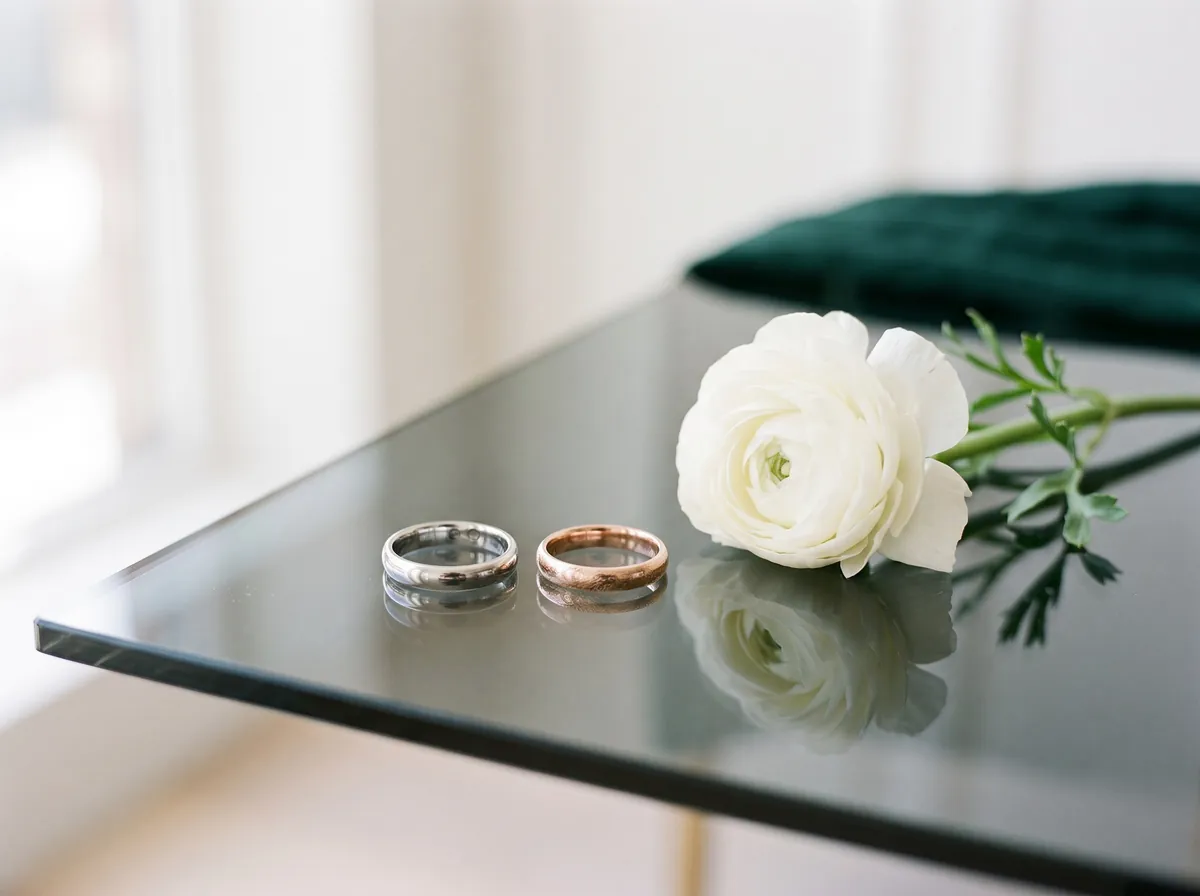
Some couples love matching bands, identical in metal and profile, perhaps differing only in width. Others choose rings that reflect each person: a slim polished band for one, a broader brushed one for the other, linked by a shared metal or a common detail. Both approaches are beautiful, and there is no rule beyond your own taste.
If the band will be worn beside an engagement ring, take that ring with you when you choose. A straight band sits neatly against settings raised high enough to clear it. Lower settings, or stones with a halo, may call for a contoured or shaped band that curves around them, so the two rings lie close together without a gap.
Finally, consider the inside of the ring. An engraving there, perhaps initials, a date or a few words that belong only to the two of you, is invisible to the world and present every day.
Size, Hand and Habit
Fingers change through the day and the seasons. They swell in heat and in the evening and are slimmer on cold mornings, so try rings on at different times and at a comfortable temperature. Wide bands cover more of the finger and often need a slightly larger size than a narrow ring, which is worth remembering if your two bands differ in width.
Which hand depends on where you are. In the United Kingdom and the United States the wedding ring is usually worn on the left hand, while in Germany, Austria and much of Eastern Europe it is usually worn on the right. Many people wear the band on the same finger as the engagement ring, and some simply choose the hand that feels right.
Choose with your hands as much as your eyes. The right wedding band is the one that feels so natural you forget it is there, until the light catches it and reminds you of the day it was given.
Questions, answered
How do platinum and white gold differ?
Platinum is naturally white, dense and develops a soft patina over time. White gold is lighter and usually rhodium plated for a bright white finish, with the plating refreshed occasionally. Both are beautiful, and the choice depends on the weight and the kind of care you prefer.
Should our wedding bands match?
Only if you would like them to. Matching bands express unity, while individual rings reflect two personalities. Many couples find a middle path: the same metal in different widths, or a shared finish or engraving that quietly connects two otherwise different rings.
Do wide bands need a different size?
Often, yes. A wider band covers more of the finger and can feel tighter than a narrow ring of the same size, so many people go up slightly. Try your chosen width before you decide, ideally at a comfortable temperature rather than first thing on a cold morning.
Three terms
- Court profile
- A band shape rounded on both the inside and the outside, known as the comfort fit.
- Rhodium plating
- A thin layer of rhodium applied to white gold to give it a bright, cool white finish.
- Patina
- The soft, satin sheen that develops on a metal surface through daily wear.
Image: AI generated illustration.