Handmade or Mass-Produced? How to Tell the Difference
Casting, stamping and the goldsmith's bench: what each method means for the piece you wear.
Turn a ring over and it begins to tell you how it was made. The inside of the shank, the seat of a stone, the tiny stamp near the back: each carries the trace of a method. Jewellery today comes from the goldsmith's bench, the casting room and the press, and each has its place. Here is how the methods work, what they mean for the piece you wear, and which signs of quality you can check yourself.
At the Bench
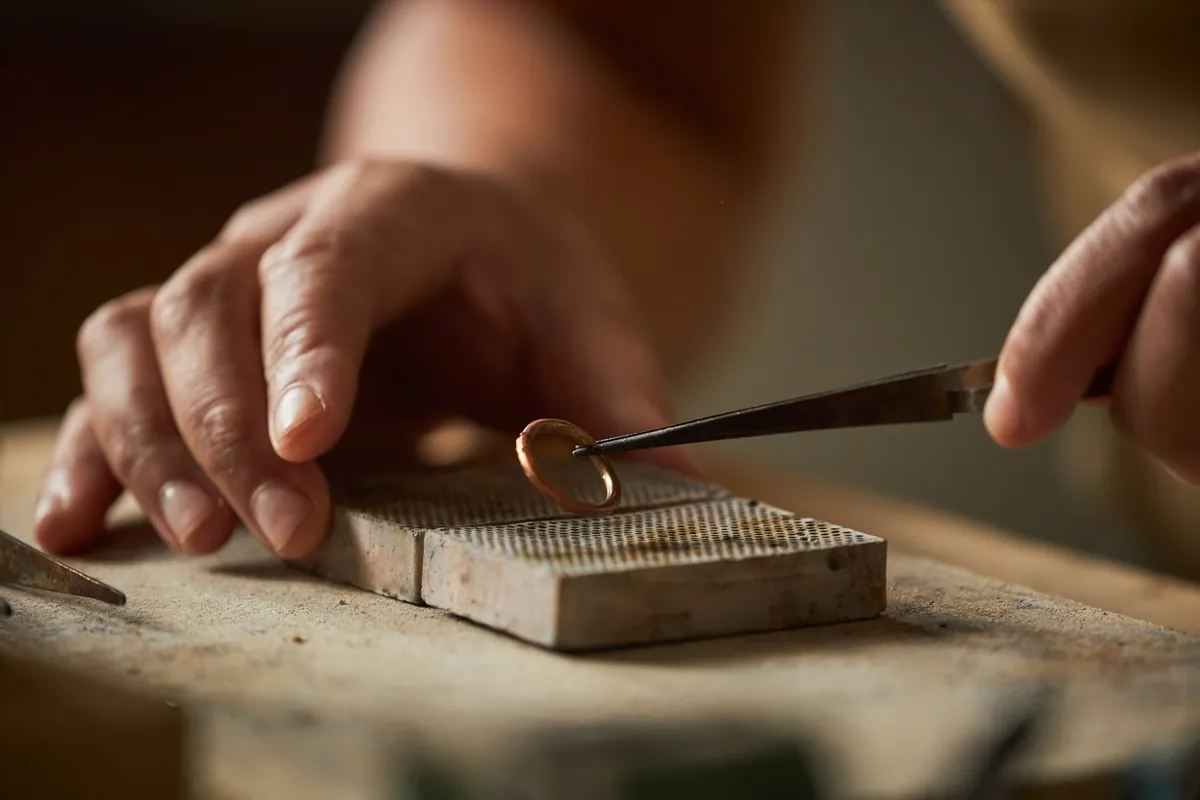
Hand fabrication is the oldest way of working metal. The goldsmith begins with sheet and wire, then forges, shapes, saws, files and solders them into form. Hammering on a steel mandrel or anvil compacts the metal, and joints are closed with a solder chosen to match the colour and fineness of the piece, flowed in with a fine flame.
The result carries the logic of the hand. Proportions can be adjusted at every stage, a band can be built for one particular finger, and a pair of earrings may differ by a hair, as two handwritten letters do. Forged metal is compact and strong, so a fabricated piece often feels dense and reassuring in the palm.
Wax, Fire and Metal
Lost-wax casting is far older than industry and remains one of the most versatile techniques in jewellery. A model is made in wax, either carved by hand or printed in resin from a design drawn on a computer. It is encased in a heat-resistant investment, the wax is burned out in a kiln, and molten metal fills the cavity it leaves behind.
Casting is not a lesser method in itself. Fine jewellers use it widely, because it captures delicate, sculptural forms that would be difficult to build from sheet, and because one master model can be reproduced with consistent precision. What decides the quality is the care that follows: the cleaning, filing, setting and polishing that turn a raw casting into a finished jewel.
For larger series, die striking, also called stamping, presses metal between hardened steel dies under great force. It produces crisp, identical pieces in volume, and the pressure leaves the metal dense. Most chain is made by machine as well, link after link, with an evenness and rhythm that hands could only approach slowly.
Reading the Clues
Can you tell the methods apart? Sometimes. Handmade work often shows small variations between a pair, a softly irregular hammered texture or the mark of an individual maker. Cast pieces tend towards fluid, sculptural shapes; stamped ones are crisp and perfectly repeated. A skilled finish can blur every line, though, and the most reliable answer usually comes from asking how a piece was made.
Look closely at the joins as well. A fabricated piece is assembled, so you may find the places where wire meets sheet, or where a setting meets the shank, cleanly soldered. A casting is born in one piece, its forms flowing into each other without seams. Neither is better; they are simply different grammars of the same language.
Signs of Quality
Whatever the method, a well-made piece reveals itself to anyone who knows where to look. Take your time, use daylight and, ideally, a loupe.
- Weight: the piece should feel substantial for its size
- The inside of the shank and the back, finished as carefully as the front
- Solder seams that are invisible or very nearly so
- Claws that are even, smooth and hold the stone securely
- A polish that is consistent, without dull patches or ripples
- A crisp fineness stamp and a clear maker's mark
- A clasp that closes firmly and opens without a struggle
The back of a piece is the most honest place to look. Where a maker has taken the trouble to perfect surfaces nobody will see, you can usually trust the ones everyone will.
What the Hand Adds
Handmade jewellery offers something beyond its materials. Each piece is individual, even within a small series, and it carries decisions made by one person. It is usually straightforward to repair and to resize, because the maker knows exactly how it was built and from which alloy.
There is also a person behind it. A goldsmith can tell you why a band is shaped as it is, how thick the metal is, how the stones are held and how to care for them. That conversation becomes part of the jewel's story. And then there are the hours: sawing, filing, soldering and polishing by hand take time, and that time explains the price of a handmade piece more clearly than any label.
Series production brings gifts of its own: consistency, accessibility and a reliable standard of finish. Many of the most loved jewellery boxes hold both.
Every method can make a beautiful jewel; only care makes a lasting one.
Handmade or machine-made, cast or forged, every piece deserves the same measure: how well it is finished, how securely it holds its stones, how it feels on the skin at the end of a long day. Learn to read those signs and you will choose with confidence, whichever method shaped the jewel you love.
Questions, answered
Is cast jewellery lower in quality than handmade jewellery?
No. Lost-wax casting is an ancient technique and is used widely by fine jewellers, especially for sculptural designs. The quality of a cast piece depends on the model, the casting itself and the finishing work that follows. A carefully cast and finished ring can be every bit as fine as a fabricated one.
How can I tell if a piece is handmade?
Look for small variations between pairs, gentle irregularities in hammered textures and the mark of an individual maker. Uniform, identical surfaces suggest a casting or a stamped series, though a skilled finish can blur the line. The most reliable answer comes from asking the maker how the piece was made.
Can mass-produced rings be resized?
Many can, depending on the design, the metal and the setting. Plain bands are usually simple to adjust, while rings set with stones all the way around, or with continuous patterns, need more thought. A goldsmith can assess the ring and explain what is possible before any work begins.
Three terms
- Shank
- The band of a ring, the part that encircles the finger.
- Lost-wax casting
- A method in which a wax model is burned out of a heat-resistant mould and replaced by molten metal.
- Die striking
- Shaping metal by pressing it between hardened steel dies under very high pressure.
Photo: licensed stock photography.