
Gold and Silver, Together
The old rule said never mix your metals. Here is how to combine yellow, white and rose with intention.
For decades the advice was firm: gold with gold, silver with silver, and never the two together. Look at the hands and wrists of the most assured dressers today and you will see that the rule has been quietly retired. Mixing metals has become a skill worth practising. Here is where the old rule came from, and how to combine yellow, white and rose with intention.
Where the Rule Began
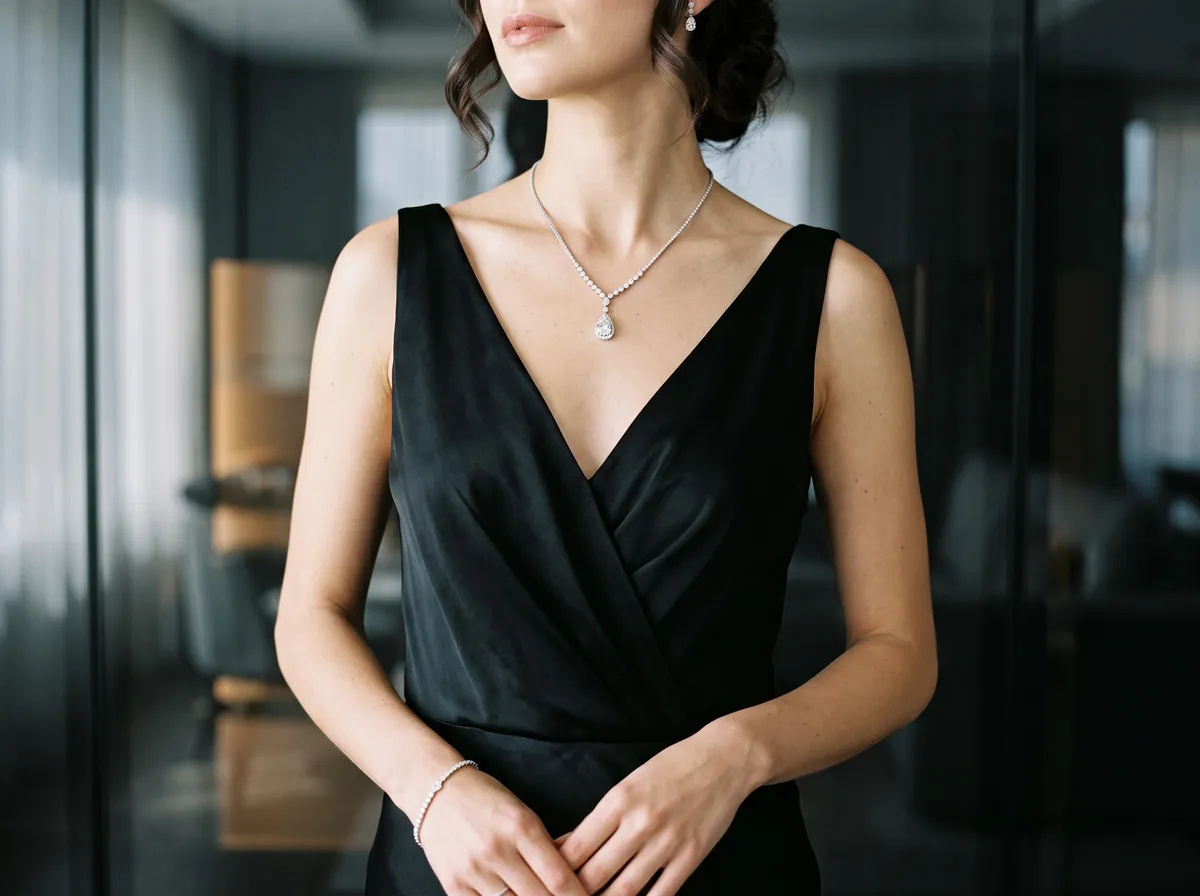
The idea of matching runs deep in jewellery history. The parure, a set of necklace, earrings, bracelet and often a brooch or tiara made to be worn together, was the height of formal adornment in the eighteenth and nineteenth centuries. Every element shared the same metal, the same stones and the same design language, because it was conceived as a single composition.
Mid-century etiquette inherited that thinking and distilled it into a simple instruction. A well-dressed woman of the 1950s matched her earrings to her necklace, her handbag to her shoes and her metals to one another. The rule offered order and reassurance.
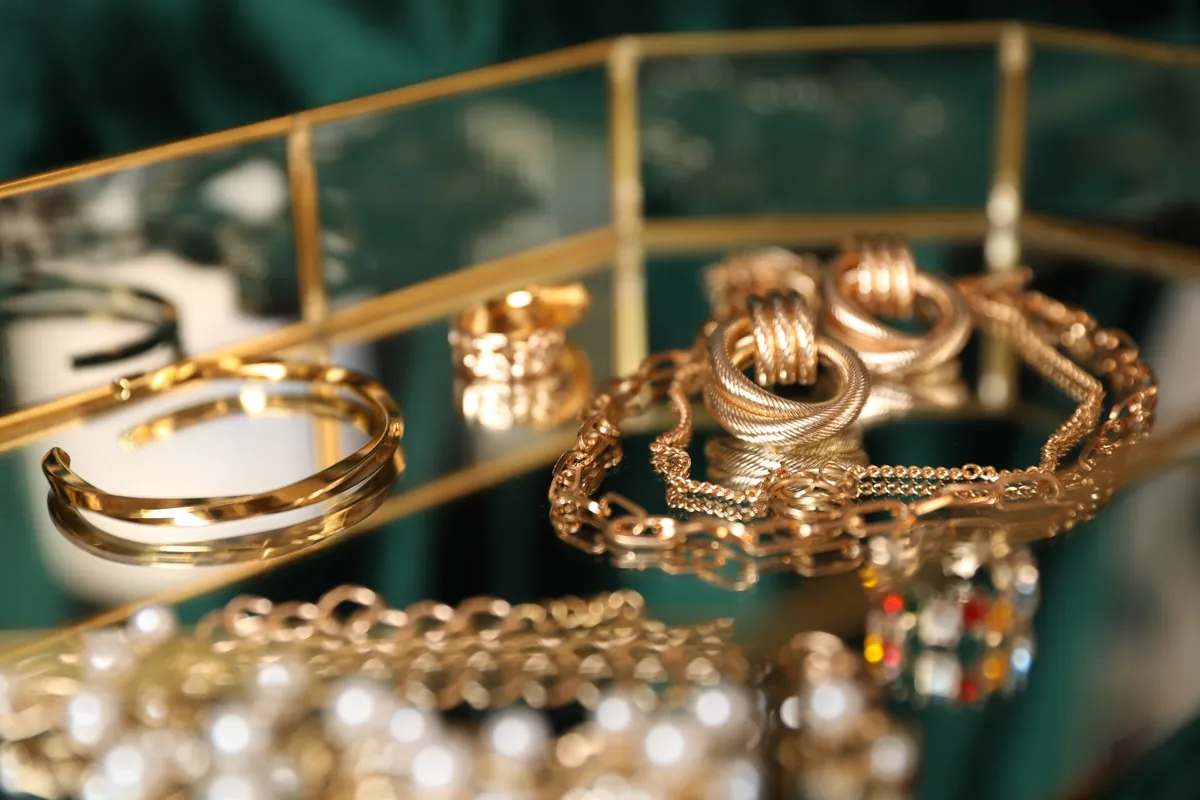
Today jewellery is gathered over a lifetime rather than acquired in sets: an inherited yellow gold ring, a white gold band, a rose gold bracelet chosen on a journey. Wearing them together reads as confident because it tells a personal story. What makes a mix look deliberate rather than accidental is a handful of quiet principles.
Principles of the Mix
Begin with a dominant metal. Let one colour account for roughly two thirds of what you wear and give the other a supporting role. The eye reads that balance as a decision rather than a coincidence.
- Repeat each metal at least twice, so no piece looks stranded
- Add bridge pieces: a two-tone watch, a mixed chain, a ring that combines metals
- Keep the finish consistent, all polished or all brushed
- Vary only one thing at a time, colour or texture, never both at once
- Think in zones: neck, wrist and hands can each hold their own conversation
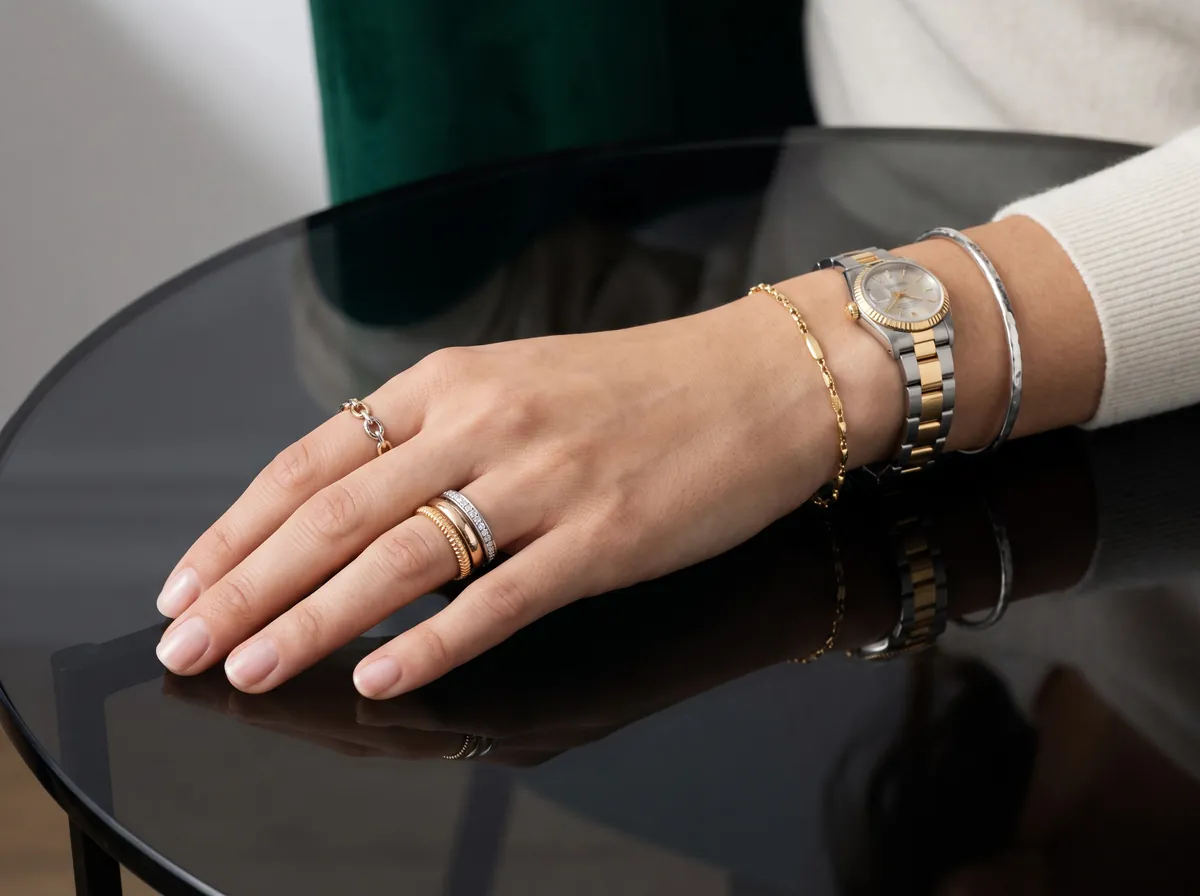
Bridge pieces are the secret of the most harmonious mixes. A ring that unites yellow and white gold, or a watch that pairs a white metal case with golden details, tells the eye that the two colours belong together. Every other piece you wear then seems to follow its lead.
Finish matters as much as colour. A high polish beside a brushed or hammered surface introduces a second variable, and two variables at once can look restless. Keep the texture steady while you play with colour, or keep one colour while you explore texture. Zones help too: yellow gold at the ears and throat, a mixed stack at the wrist and a single white band on the hand can each stand alone and still belong to one look.
Skin and Undertone
Undertone offers a gentle orientation, never a verdict. Look at the veins on the inside of your wrist in daylight: bluish veins often suggest a cool undertone, greenish ones a warm one. Cool undertones tend to glow beside white metals such as white gold, platinum and silver, while warm undertones often come alive with yellow gold.
Rose gold is the great diplomat. Its soft blush flatters almost every complexion, which is why it so often serves as the link between yellow and white. Still, personal preference wins over any theory. If a metal makes you feel like yourself, it suits you.
Stacks and Anchors
Rings and bracelets are where mixing feels most natural. On the hand, alternate the colours or group them: a cluster of yellow bands on one finger, a single white gold ring on another, a rose gold band between them as the bridge. Slim rings can sit close together; broader ones like a little space. On the wrist, bangles in all three colours make a soft, chiming stack.
The watch is the natural anchor of the wrist. A two-tone watch settles the question elegantly, since it already contains both metals. A white metal watch beside a yellow gold bracelet works beautifully when the same yellow appears once more, perhaps in your earrings or in a ring on the same hand. For a first suggestion of where your own preference lies, try the Metal Finder on valcani.
The Wardrobe Speaks
Clothing changes the picture too. Navy and grey have a natural affinity with white metals, which share their coolness and look crisp against them. Camel and olive love yellow gold, which deepens their warmth. Black, white and cream welcome every metal, which makes them the easiest canvas for a first experiment.
Fabric plays its part as well. Fine knitwear or a silk blouse softens contrasts, while a starched white shirt makes every metal look sharper. Let the outfit set the tone, then let the jewellery answer it.
Two metals worn with intention look richer than one worn from habit.
The old rule was never really about metal. It was about looking composed, and that remains the aim. Choose a dominant colour, echo the others, keep your finishes in step, and the mix will look exactly as it should: like a collection that grew with you.
Questions, answered
Can I wear a yellow gold engagement ring with a white gold wedding band?
Yes, and the pairing has real charm. Repeat each colour at least once elsewhere, perhaps in earrings or a bracelet, so the combination looks chosen. A third band that combines both metals, worn beside them, can act as a bridge and tie the stack together.
Does rose gold go with silver?
Very well. Rose gold sits between the warmth of yellow and the coolness of white, so it pairs gracefully with silver, white gold and platinum. Keep the finishes consistent, let one of the two metals lead, and the soft pink will warm the cooler tone beside it.
Should my watch match my jewellery?
Not necessarily. Treat the watch as the anchor of the wrist. A two-tone watch harmonises with almost everything, while a single-colour watch works best when its metal appears at least once more in what you wear, such as a ring on the same hand or a pair of earrings.
Three terms
- Parure
- A matched set of jewellery, typically necklace, earrings, bracelet and brooch, designed to be worn together.
- Two-tone
- Describes a piece that combines two metal colours, such as yellow and white gold, in one design.
- Undertone
- The subtle warm, cool or neutral hue that lies beneath the surface colour of the skin.
Image: AI generated illustration.