
The Fine Handbag: Leathers, Construction and Care
Full-grain or top-grain, saddle stitch or machine: what makes a handbag last for decades.
Pick up a fine handbag and your hands understand before your eyes do. The leather has weight and warmth, the stitches run in even lines, the edges feel smooth as a pebble and the clasp closes with a soft, certain click. These are not decorative luxuries but the signs of a bag built to last for decades. Here is how to read them, from the grain of the leather to the care that keeps it beautiful.
Reading the Grain
Leather is graded by the layer of the hide it comes from. Full-grain leather keeps the complete top layer, with its natural grain and tightly packed fibres intact. It is the strongest and most expressive grade, and over the years it develops a patina, a deepening of colour and sheen that records the life of the bag. Run a fingertip across it and you will feel tiny pores and natural marks, the signature of a surface left just as nature made it.
Top-grain leather is lightly sanded and finished to give a more uniform surface. It is smooth, consistent and practical, and widely used in elegant bags. Split leather comes from the lower layers once the top has been separated; it is usually finished or coated, and suede is often made from it.
One phrase deserves a second look. Genuine leather simply confirms that the material is real leather. It often describes one of the lower grades, so it tells you less than it seems to; full-grain and top-grain are the terms that speak of quality.
Calf, Lamb and Their Finishes
Calfskin is the classic choice for fine bags: fine-grained, supple and strong, it holds a structured shape without stiffness. Lambskin is softer still, with a buttery touch and a delicate surface that rewards careful handling, which is why it is loved for evening bags and quilted styles.
Two finishes change the character entirely. Saffiano leather is pressed with a fine cross-hatched pattern and sealed, which makes it scratch resistant and easy to wipe clean, ideal for a bag that works hard every day. Box calf is smooth, dense and glossy, a polished surface that gives structured shapes a crisp, formal elegance and rewards care with a deep shine.
The Art of Tanning
Tanning turns raw hide into lasting leather, and the two main methods create different personalities. Vegetable tanning uses tannins drawn from tree bark, wood and other plants. It is a slow process that produces a firm leather with a warm natural scent and a rich patina that deepens beautifully with use.
Chrome tanning uses mineral salts and works far more quickly. It gives a supple, soft leather that holds its colour well, which makes it ideal for vivid shades and relaxed silhouettes. Both methods have their place: choose vegetable-tanned leather for a bag that ages with you, chrome-tanned leather for colour that stays true.
Built to Last
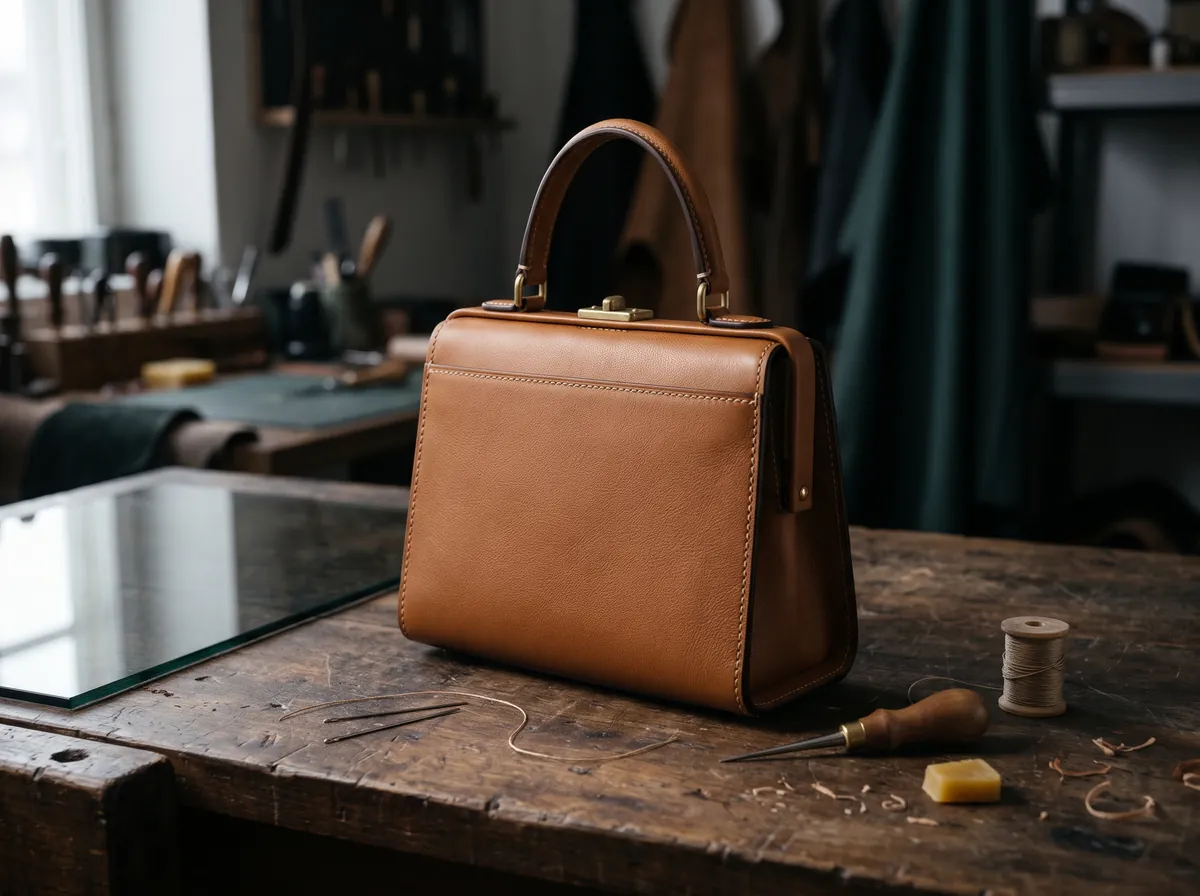
Construction is where a bag earns its decades. The finest seams are saddle stitched by hand: a single waxed thread is worked with two needles, each passing through the same hole from opposite sides. Because every stitch is locked from both directions, the seam holds even if one thread breaks. Look at stitch density too, since small, even, closely spaced stitches signal patience and strength.
The edges tell their own story. Painted edges are trimmed, sanded and sealed with several layers of edge paint, each smoothed before the next, until they feel seamless under the fingertip. Turned edges are folded over and stitched or glued, hiding the cut entirely for a soft, rounded line. Done well, both look even and feel smooth.
Then the details: hardware of solid brass, heavy in the hand and smooth in action; a lining neatly finished at every seam, with pockets that sit flat; and small metal feet on the base that protect the leather whenever the bag is set down.
Good leather remembers every journey and grows more beautiful for it.
Shapes and Care
The shapes that last tend to be the clearest: a structured top-handle bag, a soft shoulder bag, a crossbody for travel, a slim clutch for the evening. Proportion matters more than novelty, and deep or neutral colours such as black, tan, navy and burgundy carry a bag across seasons and years. Think about how you carry, too: handles long enough to sit on the shoulder over a coat, a strap you can adjust, an interior that holds what you need without straining the seams.
Care is mostly a matter of habit. Between outings, fill the bag with acid-free tissue paper to hold its shape and store it upright in its dust bag. Keep it away from direct sun, radiators and the parcel shelf of a car, where heat dries leather and light fades colour. Condition smooth leathers occasionally with a product suited to them, and rotate your bags so that each one can rest.
A well made handbag is a small piece of architecture you carry every day. Choose the leather for the life you lead, look closely at the stitches and the edges, and give it a few minutes of care now and then. In return it will soften, deepen and grow more personal with every year.
Questions, answered
What does genuine leather mean on a label?
It confirms that the material is real leather, but it says nothing about the grade, and it is often used for one of the lower ones. For a bag meant to last for decades, look for full-grain or top-grain leather, which come from the strongest layer of the hide.
Is saffiano or lambskin better for everyday use?
Saffiano is pressed and sealed, so it resists scratches and wipes clean easily, which suits a bag in daily use. Lambskin is wonderfully soft and supple but more delicate, and it is happiest on occasions when it can be carried with a little more care.
How often should a leather handbag be conditioned?
Condition smooth leather occasionally, when it begins to feel dry or looks a little dull, rather than on a fixed schedule. Test any conditioner on a hidden spot first and choose a product made for that leather. Saffiano and other sealed finishes usually need only a soft, dry cloth.
Three terms
- Full-grain
- Leather that keeps the complete top layer of the hide, with its natural grain intact.
- Saddle stitch
- A hand stitch worked with two needles on one thread, locking each stitch from both sides.
- Patina
- The deepening of colour and sheen that fine leather develops with age and use.
Image: AI generated illustration.