
Sunglasses: Finding the Frame for Your Face
Face shape, proportion and protection: how to choose sunglasses that flatter and look after your eyes.
A good pair of sunglasses does two things at once. It protects your eyes from light you cannot always feel, and it frames your face more decisively than almost any other accessory. Choosing well means beginning with the lenses, then reading the shape of your face, then trusting proportion over passing fashion. Here is how to find a frame that flatters you and looks after your eyes through every bright season.
Protection Comes First
Before you think about shape, look at the lenses. They should block ultraviolet light completely, marked as UV400 or as 100 per cent protection against UVA and UVB. A darker tint is not the same as better protection: behind a dark lens without a proper filter, the pupils open wider and let more light in, so the label matters more than the shade.
In the European Union, sunglass lenses carry a filter category from 0 to 4. Category 0 is clear or nearly clear, the middle categories cover everyday sun, and category 3 is the familiar choice for bright summer light. Category 4 is meant for intense glare in the high mountains or on snow and water, and it is too dark for driving.
Polarised lenses add another layer of comfort. They filter the glare reflected from water, wet roads and snow, so colours look calmer and your eyes can relax. They are a pleasure by the sea and on long drives, though some digital displays may look patchy through them.
Reading Your Face
Face shapes are a starting point rather than a rule, but they help you see why some frames feel instantly right. The principle is gentle contrast: a frame brings balance by adding a line the face does not already have.
- Round faces: angular and rectangular frames add definition.
- Square faces: round and oval frames, or aviators, soften a strong jaw.
- Oval faces: balanced proportions suit almost every shape.
- Heart-shaped faces: frames wider at the bottom, aviators and soft cat-eyes.
- Long faces: deeper and oversized frames shorten the face gracefully.
Use these as a map, then try on. Your colouring, your hair, the way you smile and the line of your brows all change what suits you, and the mirror always has the final word.
Proportion and Fit
Whatever the shape, proportion decides whether a frame looks made for you. The overall width should be close to the width of your face, so the frame neither pinches at the temples nor extends far beyond the cheekbones. The top line of the frame works best when it follows your brows, sitting at or just below them.
Then the bridge: it should rest comfortably on your nose without sliding down when you look at the floor or smile. Inside one of the temple arms you will usually find three numbers, the lens width, the bridge width and the temple length, all in millimetres. Once you find a pair that fits, these numbers make every future choice easier.
Consider scale as well as shape. Delicate features can disappear behind very large lenses, while strong features carry a bolder frame with ease. Step back from the mirror and look again from a few paces away, because that is how other people will see the frame on your face.
Colour, Material, Silhouette
Lens colour changes how the world looks. Grey is the neutral choice, darkening the light without altering colours. Brown heightens contrast and warms the view, which is pleasant on hazy days. Green is the classic, restful on the eyes, with natural colours and good contrast.
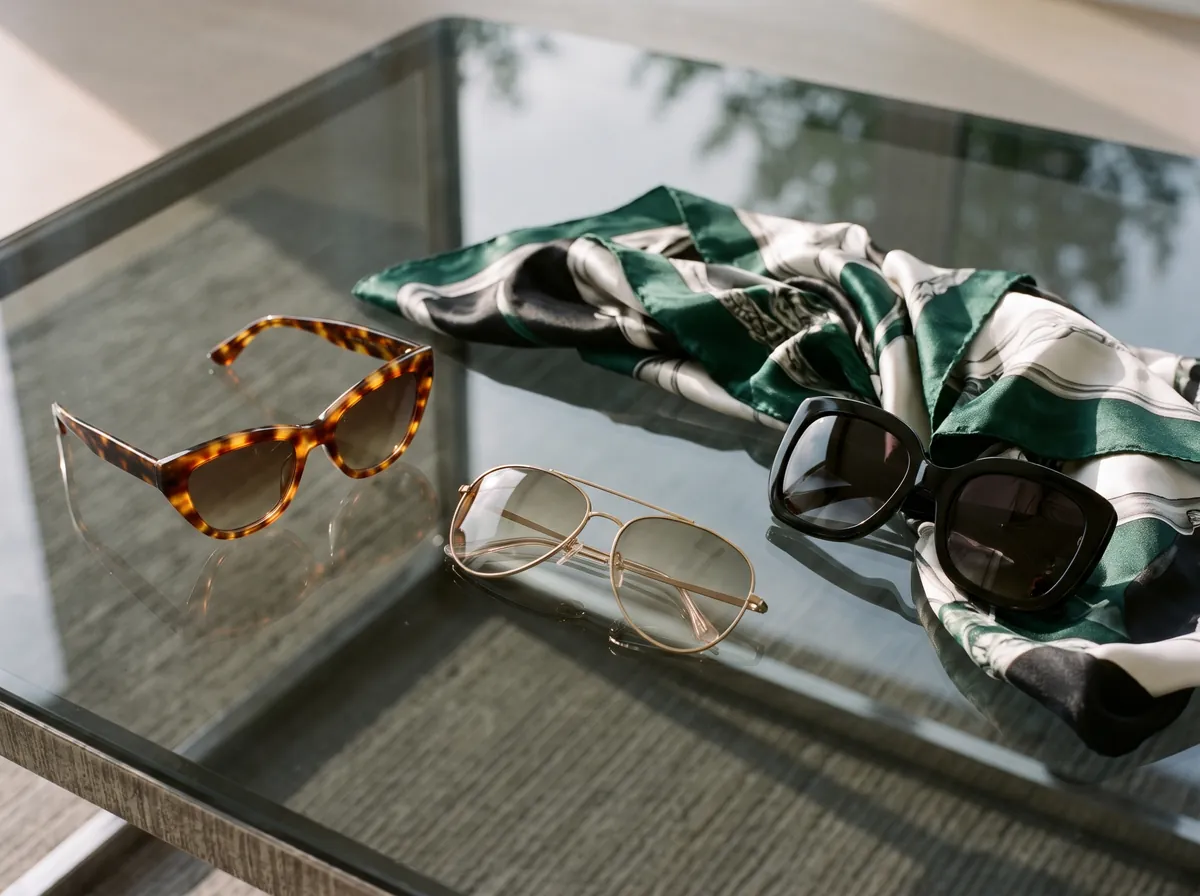
Frames come mainly in acetate, titanium and metal. Acetate is a plant-based material that takes rich colours and tortoiseshell patterns, and an optician can warm it to adjust the fit. Titanium is remarkably light, strong and kind to sensitive skin. Metal frames are fine and graphic, often with adjustable nose pads for a precise fit.
Then there are the classic shapes that return season after season. The cat-eye lifts the outer corners with a touch of mid-century glamour. The aviator, first designed for pilots, pairs a teardrop lens with a fine metal frame. The round frame feels thoughtful and a little bohemian, while oversized frames bring discretion and drama in equal measure.
Choose the lens for your eyes and the frame for your face.
Care for Clear Vision
Sunglasses ask for very little. Keep them in their case whenever they are not on your face, rather than loose in a bag or pushed up into your hair, where the arms slowly widen. Clean the lenses with a microfibre cloth, and if they are dusty or salty from the sea, rinse them first under lukewarm water with a drop of mild soap. If a hinge loosens or the arms no longer sit evenly, an optician can usually tighten and realign the frame in a few minutes.
The right pair soon becomes part of your summer face: the glasses you reach for on the way out, on the terrace and by the water. Start with protection, let the shape of your face guide you, check the fit in millimetres and choose the frame that makes you look most like yourself.
Questions, answered
Are darker sunglasses better for the eyes?
Not necessarily. Darkness describes the tint, while protection comes from the UV filter. Always look for UV400 or 100 per cent UVA and UVB protection, then choose the filter category for the light you expect, remembering that category 4 lenses are too dark for driving.
When are polarised lenses worth choosing?
Polarised lenses filter the glare reflected from water, wet roads and snow, so they are especially pleasant by the sea, on a boat and on long drives. Colours look calmer and your eyes tire less, though some digital displays may look patchy through them.
Which sunglasses suit an oval face?
An oval face has balanced proportions, so it suits most frame shapes, from cat-eye and aviator to round and oversized. Focus on fit instead: a frame about as wide as your face, a top line that follows your brows and a bridge that sits without sliding.
Three terms
- UV400
- A rating meaning the lens blocks ultraviolet light with wavelengths up to 400 nanometres, covering both UVA and UVB.
- Filter category
- The European scale from 0 to 4 that describes how much light a sunglass lens lets through.
- Acetate
- A plant-based frame material valued for its rich colours and for the way it can be adjusted with gentle heat.
Image: AI generated illustration.