
How to Recognise Quality in a Garment
Fabric, seams, lining and buttons: the details that separate fine clothing from the merely expensive.
A beautiful price tag proves very little. Quality reveals itself in places most people never look: the inside of a seam, the back of a button, the way a hem falls as you walk. Learn to read these details and you will recognise fine clothing in any light and at any level, with your hands as much as your eyes. Here is where to look, and what each detail tells you.
Begin with the Cloth
Start with the composition label, but treat it as an introduction rather than a verdict. It tells you which fibres the cloth contains, not how well they were spun, woven or finished. Two wools can feel worlds apart, so let your hand complete the story. Fine fabric has a certain density and a pleasant weight, and it feels alive rather than flat.
Three small tests are worth practising. Hold the fabric up to the light: a dense, even weave lets little light through, and any thin or irregular patches show at once. Crush a corner in your fist for a few seconds, then release it; good cloth recovers, and the creases begin to relax almost immediately. Finally, let a length of it hang from your hand and watch the drape. Fine fabric falls in soft, continuous folds and moves with an unhurried rhythm.
The Language of Seams
Turn the garment inside out, because the interior is where a maker shows respect for the wearer. Seams should run in straight, confident lines with small, even stitches and no puckering, and the raw edges should be finished. In a silk blouse you may find French seams, where each raw edge is enclosed within a second, narrow seam. In an unlined jacket you may see bound seams, wrapped in a neat strip of fabric.
Look at the width of those seam allowances too. Generous allowances leave room for a tailor to let a garment out, a quiet promise that it is meant to last through the years and through changes of figure. Then check the pattern. On a checked jacket or a striped shirt, the lines should meet across the seams, continue over the pockets and run in harmony at the collar. Matching a pattern takes more cloth and more time, and it is one of the clearest signs of care.
Inside the Jacket
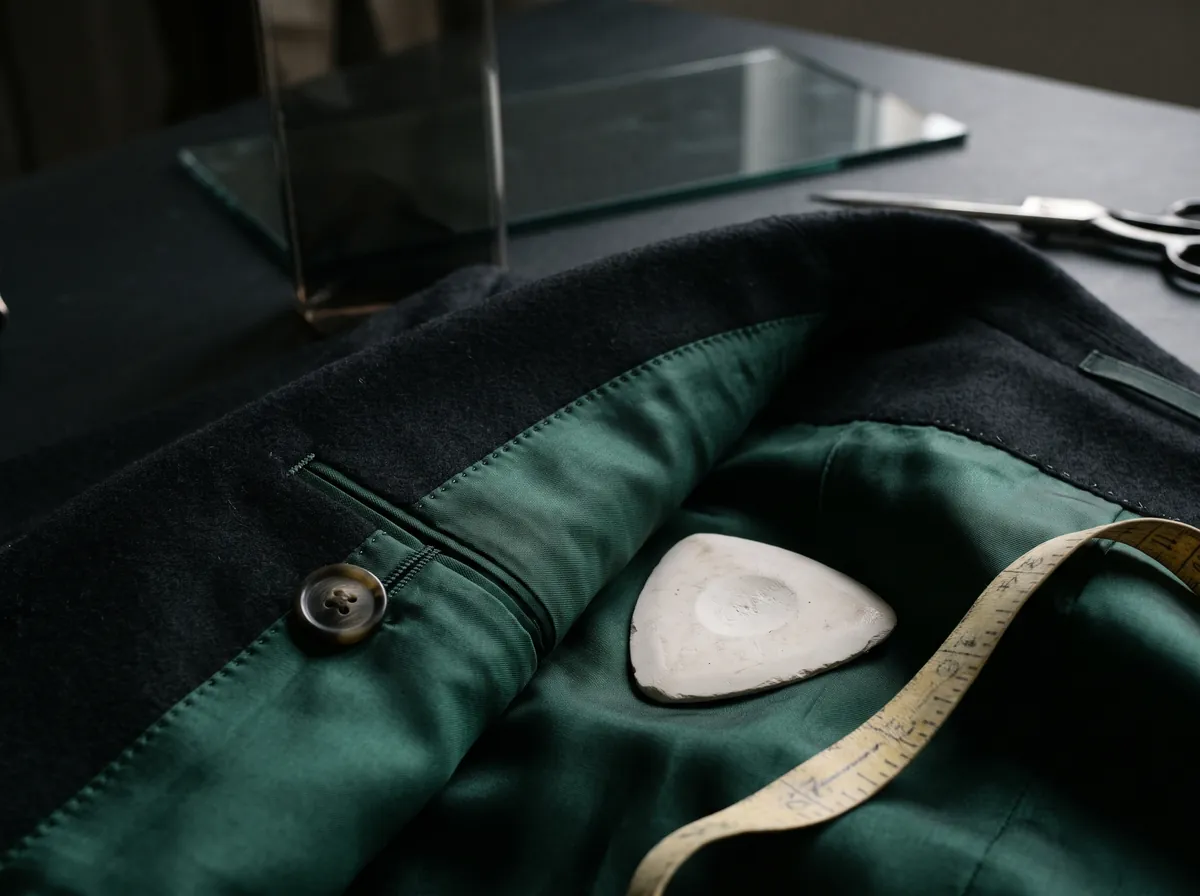
Lining deserves a moment of attention. In jackets and coats, cupro, silk and viscose are prized because they breathe, feel cool against the skin and let a garment slide on easily over a knit. Look for a vertical pleat at the centre back of the lining, and often a soft fold at the hem. These give the lining room to move with you, so that it never pulls when you reach forward.
Beneath the lining lies the interlining, the hidden architecture of tailoring. In a fused front, the interlining is bonded to the cloth with heat, which gives a crisp, even shape. In a floating canvas, a layer of canvas is stitched in and left free between cloth and lining. Warmed by the body and shaped by movement, the canvas gradually moulds itself to the wearer, so the chest and lapel gain a soft, natural roll. Gently pinch the front of a jacket below the top buttonhole: if you can feel a third, separate layer, a floating canvas is probably inside.
Buttons, Hems and Small Truths
Buttons are a small luxury with a long memory. Horn with its natural variations of tone, mother-of-pearl with its cool iridescence and corozo, carved from the tagua nut, all have a depth you can feel as well as see. A good button is sewn on with a shank, a short stem of wrapped thread that lifts it slightly from the cloth so that it closes without strain. Buttonholes should be neat and densely stitched; on fine tailoring they are often sewn by hand, with a slightly raised, corded edge.
Hems tell a similar story. A blind-stitched hem is almost invisible from the outside, held by stitches that catch only a thread or two of the outer fabric. Some fine jackets and coats are weighted at the hem, with a discreet chain or small weights sewn inside, so that they hang straight and settle cleanly after every movement. Zips should lie flat, run smoothly and sit hidden or neatly framed. Finally, step back and look for symmetry: pockets level, lapels mirroring each other, a collar resting quietly against the neck.
Luxury is never announced on the label; it is sewn into the seams.
The Fitting Room Test
A garment can pass every visual inspection and still have to prove itself in motion. Before you decide, move in it as you would on an ordinary day.
- Raise both arms and check that the jacket does not climb far up your back.
- Reach forward as if across a table and feel whether the shoulders pull.
- Sit down and notice whether the seat or hips feel strained.
- Cross your arms and watch the back for tension lines.
- Turn to look over your shoulder and check that the collar stays close to the neck.
Recognising quality is a matter of attention rather than budget. Once your eyes and fingers have learned the language, you will find it everywhere: in a perfectly matched stripe, in a buttonhole sewn by hand, in a hem that falls straight as you walk away. Price is not proof. Details are.
Questions, answered
What is the quickest way to judge a jacket in a shop?
Look inside before you look at the label. Check that the seams are straight and finished, that the lining has a pleat at the back and that the buttons are sewn on with a shank. Then pinch the front below the top buttonhole to feel for a floating canvas.
What is the difference between a fused and a canvassed jacket?
In a fused jacket, the interlining is bonded to the cloth with heat, which gives a crisp, consistent front. In a canvassed jacket, the canvas is stitched in and floats freely, so over time it moulds to your body and gives the chest and lapels a soft, natural roll.
Why do generous seam allowances matter?
They give a tailor room to let a garment out at the waist, hips or sleeves, so that it can follow changes in your figure over the years. Generous allowances are a sign that a piece was made to be cared for, altered when needed and worn for a long time.
Three terms
- French seam
- A seam in which the raw edges are enclosed within a second, narrow seam, leaving a clean finish inside.
- Floating canvas
- An interlining of canvas stitched into a tailored jacket rather than bonded, so that it can mould to the wearer.
- Corozo
- A button material carved from the hard, dried seed of the tagua palm, often called vegetable ivory.
Image: AI generated illustration.