From Sketch to Ring: Inside a Goldsmith's Workshop
Drawing, wax, fire and polish: how a ring is made by hand, step by step.
Every handmade ring begins at a small, well-worn wooden bench, under a lamp, with a person who knows how metal behaves in fire. Between the first sketch and the final polish lie dozens of quiet steps, some ancient, some helped by modern tools. Here is what happens inside a goldsmith's workshop, how a ring takes shape by hand, and how you can commission one of your own.
The Bench
The heart of the workshop is the bench, a sturdy table with a curved hollow cut into its front so the goldsmith can sit close to the work. At its edge juts the bench peg, a wedge of wood that supports a ring while it is sawn, filed and shaped. Beneath it hangs a leather apron, slung like a hammock to catch every precious filing that falls.
Within reach lies a familiar company of tools: a fine piercing saw, files of many shapes and cuts, a tapered steel ring mandrel, a torch with its soft hiss of flame, a polished burnisher and a loupe for checking detail. Nothing here is decorative. Each tool is worn to the hand that uses it, and the air smells faintly of flux and warm metal.
A Conversation and a Sketch
Before any metal is touched, there is a conversation. The goldsmith asks how you live, which hand will wear the ring, what you love and what you would never wear. From that talk comes a sketch, drawn in pencil and often washed with colour, or a rendering made on a computer that lets you see the proportions from every side.
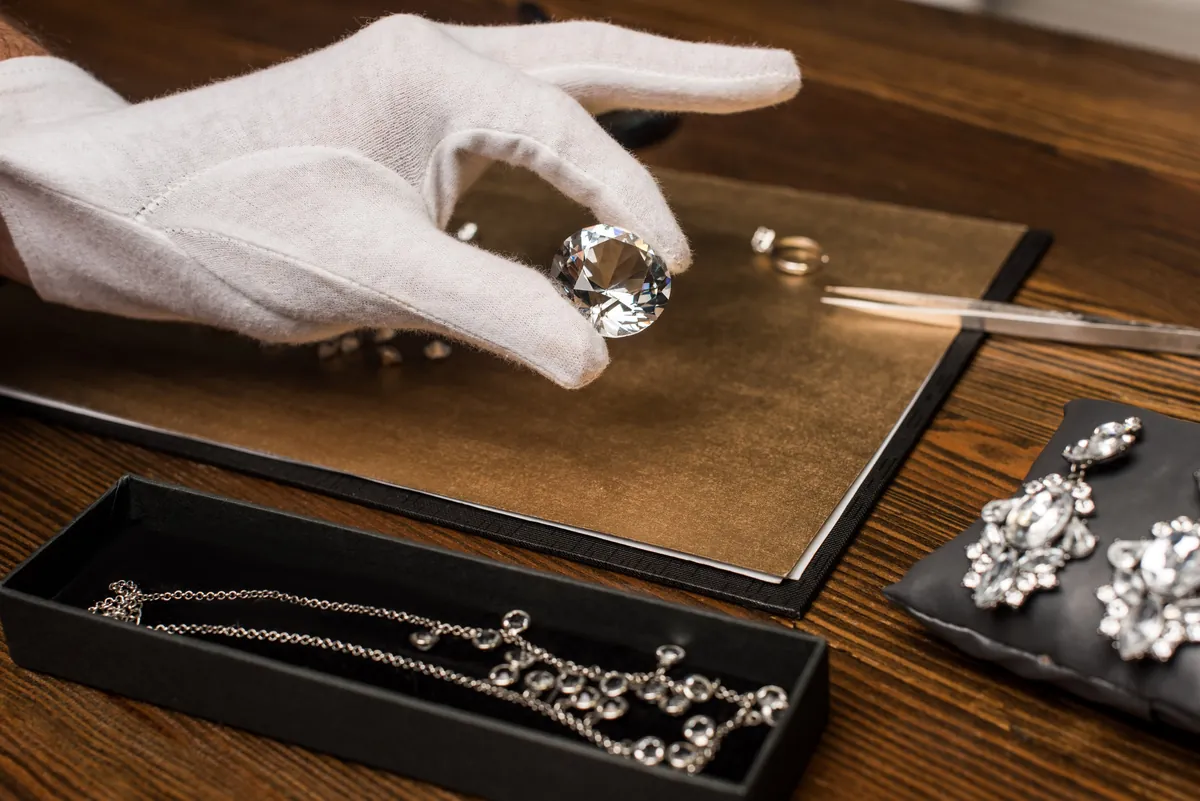
Together you choose the metal: yellow, rose or white gold, perhaps 18 carat for its rich colour, or platinum for its density and natural whiteness. The stone is chosen at the same time, because its size and shape decide the height of the setting, the width of the band and the way light will enter it. Your finger is measured, ideally more than once and at different times of day.
Two Routes to a Ring
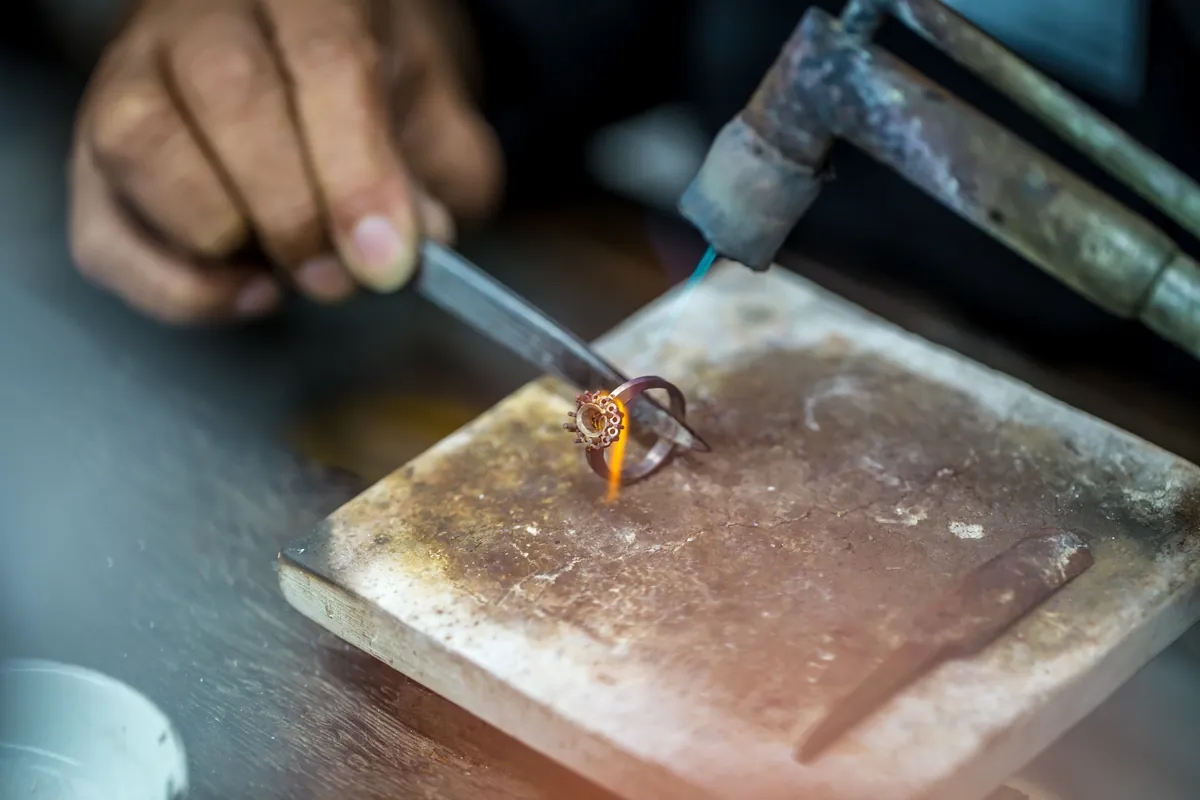
The first route is hand fabrication. Metal is melted in a crucible, poured into an ingot and passed through a rolling mill to make sheet, or pulled through a drawplate to make wire of exactly the right thickness. The goldsmith forges it with hammers, softens it again and again in the flame, bends it round the mandrel and closes the seam with solder, an alloy that melts at a slightly lower temperature and flows into the join.
The second route is lost-wax casting, a method thousands of years old and widely used by fine jewellers today. A model is carved by hand from jewellers' wax or printed in resin from a computer design. It is fixed to a wax stem called a sprue, placed in a steel flask and surrounded with liquid investment, a fine plaster that sets around it. In the kiln, the wax burns away and leaves a perfect hollow.
Molten metal is then poured into that hollow, often helped by centrifugal force or a vacuum. After a short pause the flask is quenched in water, the investment crumbles, and the rough casting is broken out, still attached to its sprue. The film on this page shows the flame at work in exactly these moments, when the metal is glowing and alive.
Fire shapes the metal; patience and a steady hand shape the ring.
Setting the Stone
Whichever route it took, the ring now needs careful cleaning up. Sprues are cut away, surfaces are filed and smoothed with ever finer emery paper, and the size is adjusted on the mandrel. Only then does the stone setting begin, sometimes by the same goldsmith, sometimes by a specialist setter at the next bench.
For a claw setting, a small seat is cut into each claw so that the stone sits level, and the claws are then raised over its edge and shaped smooth. A bezel is pressed down around the stone with a pusher and burnished until the metal hugs it completely. Pavé is the most patient work of all: under a microscope, the setter uses gravers to raise tiny beads of metal that hold each small stone in place.
Polish, Marks and Patience
Polishing happens in stages, from coarser compounds to the finest, until the surface reflects like a mirror, or until it receives the satin or hammered texture the design calls for. White gold is usually given a thin rhodium plating for a bright white sheen. The fineness stamp and the maker's mark are struck inside the band, small signatures of responsibility.
Final checks follow. Every stone is examined for movement under the loupe, claws are felt for rough edges that might catch on knitwear, and the inside is shaped so that the ring sits comfortably. Depending on the design, the whole journey takes anything from many hours to several weeks.
Commissioning a ring asks for a little patience, and it repays that patience generously. You come away with a piece made for your hand and your story, and with the memory of every step it passed through, from the first pencil line to the moment it first caught the light.
Questions, answered
How long does it take to make a ring by hand?
It depends on the design. A simple band may take many hours of bench work, while a ring with a complex setting or pavé can take several weeks, including the time needed for sketches, casting, stone setting and polishing. Ask your goldsmith for a realistic timeline at the first meeting.
Is a cast ring less valuable than a hand-fabricated one?
No. Lost-wax casting is an ancient and respected technique used widely by fine jewellers. It allows shapes that would be difficult to build from sheet and wire. Both routes need skilled hands for finishing, setting and polishing, which is where much of the quality lies.
What should I bring when commissioning a ring?
Bring images and ideas, whether of rings or of textures and objects you love, a clear budget and the date you need the piece. If you have a stone or an heirloom you would like to use, bring that too, so the goldsmith can plan around it.
Three terms
- Bench peg
- A wedge of wood fixed to the front of a goldsmith's bench that supports work while it is sawn and filed.
- Investment
- A fine, plaster-like material poured around a wax model in lost-wax casting, which hardens to form the mould.
- Graver
- A small, sharp steel hand tool used to cut metal and raise the tiny beads that hold pavé stones.
Photo: licensed stock photography.