
Pearls, Reconsidered
Akoya, South Sea, Tahitian and freshwater: how to read lustre, size and colour, and why pearls feel modern again.
For a long time pearls seemed to belong to another generation: the twinset, the graduated strand, the careful string of white. Look again. A single baroque drop on a fine chain, a dark Tahitian pearl against a grey jumper, a rope of freshwater pearls worn with denim: the gem has slipped its formality. Here is how pearls are made, how the four great families differ and how to read a pearl with your own eyes.
How a Pearl Begins
Pearls are among the very few gems grown by a living creature. When an irritant finds its way inside an oyster or a mussel, the animal coats it in nacre, layer upon microscopic layer of calcium carbonate held together by an organic binder. Over time those layers build a sphere, a teardrop or a free-form shape, and the light that travels through them gives the pearl its soft inner glow.
Natural pearls form entirely by chance, which is why they have always been rare and today appear mostly in antique jewellery. At the end of the nineteenth century, pioneers in Japan developed a way to start the process by hand: a small nucleus, or a sliver of tissue, is placed inside the mollusc, which then does the rest. Almost all pearls sold today are cultured, and the word describes how the pearl began, not any lack of authenticity. The nacre is still made by the animal, slowly, in water.
Four Families
Akoya pearls come from the Pinctada fucata oyster, cultivated in Japan and China. They are typically 6 to 9 mm, very round and known for a high, almost mirror-like lustre. Their colour is white or cream, often with a rosy overtone that warms the skin. This is the classic strand of the cocktail hour, crisp and luminous.
South Sea pearls grow in the larger Pinctada maxima oyster in the waters of Australia, Indonesia and the Philippines. They are usually 9 to 16 mm, with a soft, satiny glow in white, silver or a deep golden tone. Tahitian pearls come from the Pinctada margaritifera oyster of French Polynesia and are naturally dark: grey, green, peacock and aubergine, sometimes all within a single strand.
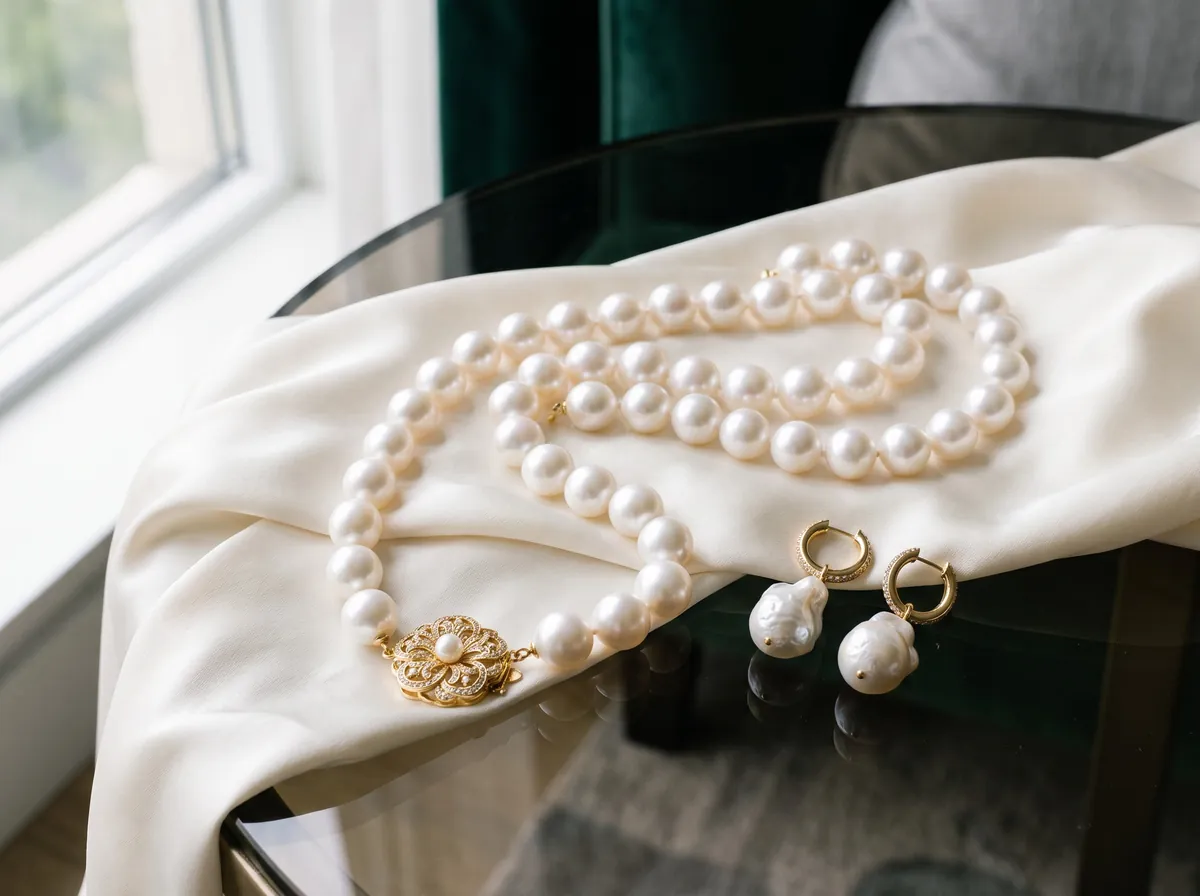
Freshwater pearls are cultured in mussels, mostly in China. They appear in a wide range of shapes and colours, from perfect rounds to rice grains, coins and petals, and many are solid nacre right through, because they often grow around a piece of tissue rather than a bead. They are the most playful of the four, and the most generous in variety.
Reading a Pearl
Lustre comes first. Hold a pearl under a soft light and look at the reflection on its surface: in a fine pearl it is sharp and bright, with a sense of depth, as if the light came from inside. Surface follows. Small marks are natural, and the fewer and less visible they are, the cleaner the pearl reads. Shape runs from round and near-round to drop, button and baroque, and each has its own charm.
Size matters within each type rather than across them, since a 9 mm Akoya and a 9 mm South Sea pearl are quite different creatures. Nacre quality decides how long the beauty lasts: thick, even layers carry the lustre for generations. On a strand, matching is the final test. Lay it on a white cloth and the pearls should agree in colour, lustre and size, or graduate in an even rhythm; rolling the strand a little shows how round they truly are.
A pearl does not sparkle. It glows, and it asks you to come closer.
Pearls, Unbuttoned
The new pearl wardrobe is lighter and more personal. A single pearl on a fine chain sits close to the collarbone and works from breakfast to dinner. Baroque pearls, with their irregular, molten shapes, feel sculptural and never prim; worn as one large drop or a short strand, they catch the light differently with every movement.
Pearls also love company. Layer a short pearl strand with one or two gold chains of different weights and the pearls lose their formality at once. Wear them with what you actually live in: a cream pearl against a navy cashmere jumper, a Tahitian strand with a crisp white shirt, a freshwater rope with denim and a camel coat. The contrast between a soft gem and everyday fabric is what makes it feel modern.
A Gentle Ritual
Nacre is soft and sensitive to acids, so perfume, hairspray and cream should go on first and settle before your pearls do: last on, first off. At the end of the day, take them off before anything else and wipe them with a soft, slightly damp cloth, then let them dry. That simple ritual removes the traces of skin and cosmetics that would slowly dull the surface.
Store pearls flat in a soft pouch or a lined compartment, away from harder gems and metal that could scratch them. Hanging a strand stretches the silk over time. Pearls also prefer a little air, so avoid sealing them in plastic for long periods. A strand that is worn often loosens gradually, and when small gaps appear between the knots, it is ready to be restrung.
Perhaps that is the quiet secret of pearls: they reward attention rather than demand it. They warm to the skin within minutes, they soften every colour they sit beside, and they look as right with a sweater as with silk. Choose one you love, wear it often, and let it become part of your own story.
Questions, answered
What is the difference between natural and cultured pearls?
Both are made of nacre grown by a living mollusc. A natural pearl forms by chance around an irritant, which makes it very rare. A cultured pearl begins with a nucleus or a piece of tissue placed by hand, after which the animal builds the nacre in exactly the same slow way.
Which pearls are naturally dark?
Tahitian pearls, grown in the Pinctada margaritifera oyster of French Polynesia, are naturally dark. Their colours range from grey and green to peacock and aubergine. In the finest examples an overtone seems to float over the body colour, so the same pearl can look different by daylight and by candlelight.
How often should a pearl strand be restrung?
There is no fixed calendar, because it depends on how often you wear the strand. Look at the knots: when small gaps appear between the pearls and the silk looks stretched or discoloured, it is time. A strand worn every week will need fresh silk sooner than one kept for special evenings.
Three terms
- Nacre
- The iridescent material of fine calcium carbonate layers that a mollusc secretes to build a pearl and line its shell.
- Lustre
- The brightness and sharpness of light reflected from the surface of a pearl and from within its layers of nacre.
- Baroque pearl
- A pearl with an irregular, asymmetrical shape, prized for its individuality and sculptural character.
Image: AI generated illustration.