
Sapphire, Ruby, Emerald: The Big Three
The precious coloured gemstones explained: colour, origin, treatments and how to wear them every day.
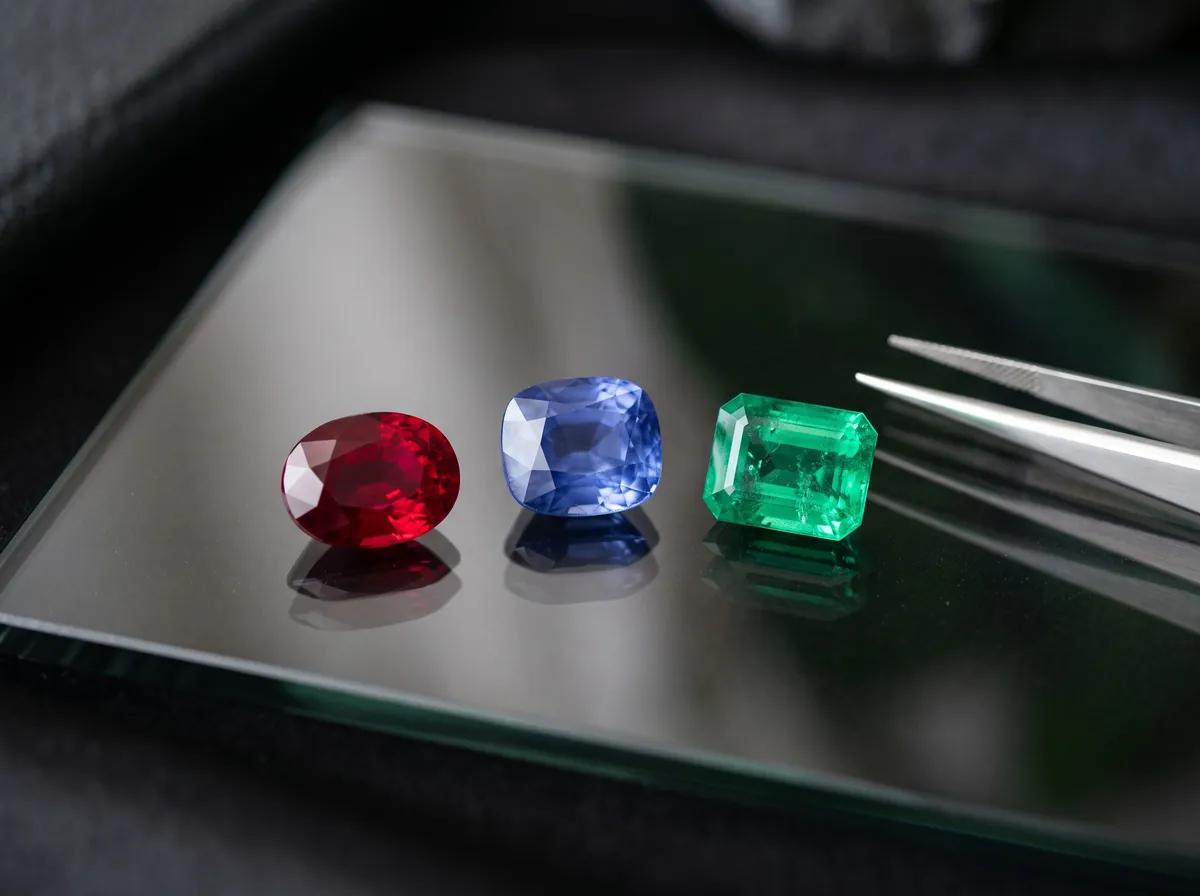
Three stones have carried the idea of colour in jewellery for centuries: the red of ruby, the blue of sapphire, the green of emerald. Together they are known as the precious coloured gemstones, and they reward a little knowledge. Here is what they are made of, where the great stones have come from, how treatments work, how to judge colour and how to wear each of them with confidence every day.
One Mineral, Two Names
Ruby and sapphire are, in fact, the same mineral. Both are corundum, a crystalline form of aluminium oxide that ranks 9 on the Mohs scale of hardness, second only to diamond among the classic gems. What separates them is a whisper of trace elements. Chromium turns corundum red, and red corundum is ruby. Every other colour is called sapphire.
Blue, the colour most people picture, comes from iron and titanium working together in the crystal. Yet sapphires also appear in pink, yellow, green, violet, orange and colourless forms, usually called fancy sapphires. The rarest of them is padparadscha, a delicate blend of pink and orange whose name is generally traced to the Sinhalese word for the lotus flower. Seen in daylight, a fine one seems to hold a sunset.
The Emerald Garden
Emerald belongs to a different family altogether. It is a beryl, the same mineral species as aquamarine, coloured green by chromium or vanadium. At 7.5 to 8 on the Mohs scale it is hard enough to resist everyday scratches, yet its crystal tends to carry tiny fissures and inclusions that make it more sensitive to knocks than ruby or sapphire.
Jewellers have a lovely name for those inclusions: the jardin, French for garden. Look into an emerald under a loupe and you may see mossy threads, tiny crystals and soft veils suspended in green, a landscape unique to each stone. A completely clean emerald is exceptional. For most, the garden is simply part of the character, as personal as a fingerprint.
Origin and Treatment
Each of the three has a classic homeland in the history of jewellery. Burma, today Myanmar, became famous for rubies of a vivid, glowing red. Kashmir and Ceylon, today Sri Lanka, gave their names to celebrated sapphires, and Colombia is the classic source of emeralds. Today the map is far wider, with fine material from Mozambique, Madagascar, Zambia, Brazil and many other places. A historic name adds romance and a story, but the beauty lives in the stone itself, so let your eye lead.
Treatments are a long-standing part of the gemstone world, and the important word is disclosure. Many rubies and sapphires are gently heated to deepen and even out their colour or to improve clarity, a widely accepted practice. Emeralds are traditionally oiled, or filled with resin, so that their tiny fissures become less visible. A good jeweller tells you what has been done, in writing, so you know exactly what you are wearing and how to look after it.
Colour Before Everything
With coloured gems, colour leads and everything else follows. Gemmologists describe it in three parts. Hue is the colour itself (red, blue or green) with any secondary tint. Tone is how light or dark it is. Saturation is its intensity, from greyish to vivid. The finest stones sit in a middle tone with strong saturation: rich and glowing, but never so dark that they turn inky by evening light.
Clarity comes next, judged more gently than with diamonds because coloured stones naturally carry inclusions, emeralds most of all. What matters is that nothing distracts the eye or weakens the stone. Cut is about life and evenness: a well-cut stone glows across its whole face, without a glassy, see-through window at the centre. Carat weight comes last, and a smaller stone of beautiful colour is often lovelier than a larger, paler one.
Colour is the first thing you see and the last thing you forget.
Living With Colour
Sapphire is the most practical of the three. Its hardness and toughness make it an ideal stone for a ring worn every day, including an engagement ring, and it handles the rhythm of ordinary life with ease. Ruby, being the same mineral, is just as durable, which is why both suit rings, bracelets and every piece that lives on your hands.
Emerald asks for a little more thought. Choose a protective setting, such as a bezel that encircles the edge of the stone, and consider the emerald cut, whose bevelled corners protect the most vulnerable points of the crystal. Earrings and pendants lead a gentler life than rings, which makes them a lovely way to wear emeralds daily.
Cleaning follows the same logic. Rubies and sapphires are happy with lukewarm water, a drop of mild soap and a soft brush. Emeralds should never go into an ultrasonic cleaner, whose vibrations can disturb the oil or resin in their fissures; a soft, slightly damp cloth is all they need.
Red, blue and green: three colours, two minerals, endless nuances. Learn to look for hue, tone and saturation, ask about treatment, and choose the setting that suits your days. Then the big three stop being museum pieces and become what they were always meant to be, colours you carry with you.
Questions, answered
Are ruby and sapphire really the same stone?
They are the same mineral, corundum, which ranks 9 on the Mohs scale. Traces of chromium make it red, and only red corundum is called ruby. Blue sapphire owes its colour to iron and titanium, and every other colour, including the pink-orange padparadscha, is a sapphire too.
Why are emeralds more delicate than rubies and sapphires?
Emerald is a beryl of 7.5 to 8 on the Mohs scale, and it usually carries tiny inclusions and fissures. They give the stone its character but make it more sensitive to knocks. Protective settings, the emerald cut and gentle cleaning without ultrasonic cleaners keep it beautiful.
Are gemstone treatments normal?
Yes, many coloured gemstones are treated. Rubies and sapphires are commonly heated to improve colour and clarity, while emeralds are often oiled or filled with resin. Treatment is an accepted practice; what matters is that it is disclosed in writing, so that you know how to wear and clean the stone.
Three terms
- Corundum
- The mineral, a crystalline aluminium oxide, that forms both ruby and sapphire.
- Jardin
- The French word for garden, used for the natural inclusions that give each emerald its inner landscape.
- Padparadscha
- A rare sapphire of a delicate pink-orange colour, its name generally traced to the Sinhalese word for the lotus flower.
Image: AI generated illustration.