Mechanical, Automatic, Quartz: What Moves a Watch
Mainspring, rotor or crystal: the three hearts of a watch and what each means for the person who wears it.
Turn a fine watch over and you may find a tiny world in motion: wheels, springs and a balance swinging with the patience of a metronome. Or you may find stillness, and a crystal humming far beyond the range of hearing. Every watch has a heart, and there are three main kinds. Here is how each one works, what it asks of you and which might suit the way you live.
The Wound Spring
The oldest of the three is the hand-wound mechanical watch, and its logic is beautifully physical. Turning the crown tightens the mainspring, a coiled ribbon of metal inside a small drum called the barrel. As the spring slowly relaxes, it releases its stored energy into the gear train, a sequence of wheels that passes the force along and turns it into the measured progress of the hands.
Left alone, that energy would spill out in seconds. The escapement prevents this. It locks and unlocks the gear train in steady steps, and with each release it gives a small push to the balance wheel, which swings back and forth on a fine hairspring. The regular rhythm of the balance is what keeps time. Many modern movements beat at 28,800 vibrations per hour, or 4 Hz: eight ticks every second, which is why the seconds hand of a mechanical watch seems to glide. The film on this page shows a balance wheel at work.
Look closer and you will see jewels. These are synthetic rubies, set at the points where the axles of the wheels turn, because their hard, smooth surfaces reduce friction and wear. A fully wound mainspring commonly offers a power reserve of around 40 to 80 hours, so a hand-wound watch likes to be wound at roughly the same time each day. Many owners come to treasure that small morning ritual.
A Weight That Follows You
The automatic watch keeps everything described above and adds one elegant idea. A rotor, a weighted half-disc mounted on the back of the movement, turns freely as your wrist moves. Through a series of small wheels, those turns wind the mainspring for you. Reach for a cup, gesture in conversation, walk to the station, and the watch quietly gathers energy. A slipping mechanism keeps the spring from being overwound.
The self-winding principle goes back to the eighteenth century, in the age of the pocket watch, and is often credited to the watchmaker Abraham-Louis Perrelet. It found its natural home in the 1920s, when the first self-winding wristwatches appeared. The wrist, never quite still, proved the perfect engine.
An automatic worn every day simply keeps running. Set it aside for a weekend and it may stop, which is easily remedied with a few turns of the crown and a reset of the hands. Some collectors keep their automatics on a watch winder, a small box that turns them gently while they rest.
A mechanical watch keeps time, and in doing so, keeps you company.
The Singing Crystal
Quartz works on another principle altogether. A battery sends a tiny electric current through a sliver of quartz, cut in the shape of a tuning fork, and the crystal responds by vibrating 32,768 times per second. A circuit counts those vibrations and, once a second, sends a pulse to a miniature motor that advances the hands. That is why the seconds hand of most quartz watches moves in one crisp step.
The result is remarkable precision: a quartz watch is typically accurate to a few seconds per month. The first quartz wristwatch appeared in 1969 and brought exact timekeeping within reach of almost everyone. Quartz also offers practical grace. It runs for years on a single battery and is ready the moment you fasten the strap.
Tested for Precision
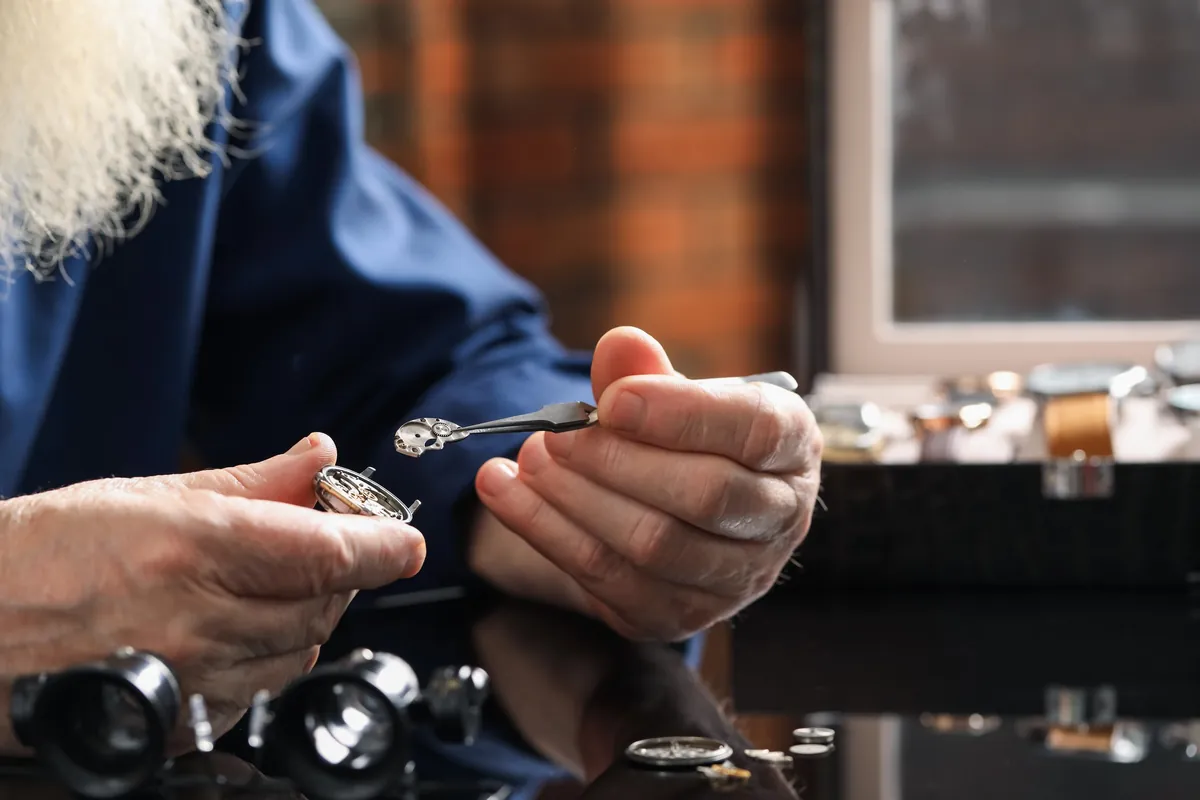
A fine watch can earn a further distinction. A chronometer is a watch whose movement has passed official tests for precision, carried out by an independent institute. Mechanical movements are observed for several days, in different positions and at different temperatures, and only those that stay within strict limits receive their certificate. It is a quiet badge of honour, often noted on the dial.
Precision lasts when it is cared for. A mechanical movement relies on minute quantities of oil, which slowly age, so it benefits from a service every few years, as advised by its maker. A watchmaker will dismantle, clean, lubricate and regulate it, then check its water resistance. A quartz watch needs a new battery from time to time and, like any watch, a periodic check of its seals.
Which Heart Suits You
Choose a hand-wound watch if you enjoy ritual and intimacy with your objects. It is often slimmer, since it carries no rotor, and the daily winding becomes a grounding gesture. Choose an automatic if you wear one watch most days and like mechanical craft that asks almost nothing of you in return.
Choose quartz if you move between several watches, wear a piece for occasions or simply value exactness and ease. A quartz watch can be just as finely made and finished, and it is ready whenever you are. Many collections end up holding more than one heart: an automatic for everyday, a hand-wound piece for quiet evenings, a quartz watch for travel.
In the end, the choice is less about technology than temperament. Some people love the soft tick and the feel of the crown turning beneath their fingers; others love the calm certainty of a crystal keeping steady pace. Each heart has its own poetry. Listen to yours, and the right watch will feel less like an accessory than a companion.
Questions, answered
How often should a mechanical watch be serviced?
Follow the maker's advice, which usually means a service every few years. The watchmaker dismantles, cleans, lubricates and regulates the movement, then checks its water resistance. Regular care keeps the oils fresh and the timekeeping steady, and it allows a fine mechanical watch to be enjoyed for generations.
Can I wind an automatic watch by hand?
Many automatic movements can also be wound through the crown, which is useful when the watch has been resting and has stopped. A few gentle turns set the balance swinging again. After that, everyday wear and the turning rotor keep the mainspring supplied with energy.
What does it mean when a watch is a chronometer?
A chronometer is a watch whose movement has passed official precision tests carried out by an independent institute. The movement is observed over several days, in different positions and temperatures, and must stay within strict limits. The word on a dial signals timekeeping that has been examined and confirmed.
Three terms
- Escapement
- The mechanism that releases the energy of the mainspring in small, regular steps and keeps the balance wheel swinging.
- Power reserve
- The length of time a fully wound watch will run before it stops, commonly around 40 to 80 hours.
- Rotor
- The weighted, freely turning part of an automatic movement that winds the mainspring as the wrist moves.
Photo: licensed stock photography.