
Complications, Explained
Date, moonphase, chronograph, perpetual calendar: what the extra hands and windows of a fine watch actually do.
Look closely at a fine watch and you may see far more than the time: a small window with the date, a painted moon drifting across a tiny sky, a ring of numbers for measuring speed. Watchmakers call these extras complications, and each one is a small feat of engineering. Here is what they do, how to read them and how to care for them.
Beyond the Hours
In watchmaking, a complication is any function beyond hours, minutes and seconds. The word sounds daunting, but the idea is simple. Every extra piece of information, whether a date, a second time zone or a stopwatch, requires additional wheels, levers and springs inside the case, and all of them must work in harmony with the timekeeping itself.
Reading a complicated dial is easier than it looks. Start with the main hands, then let your eye travel outwards. Small windows, called apertures, usually show the date, the day or the moon. Smaller dials within the main dial, known as subdials, often count elapsed minutes or hours, or carry a running seconds hand. Extra central hands and scales around the edge belong to functions such as a second time zone or a speed scale. Once you know the vocabulary, the dial reads like a well-set page.
Calendars and the Moon
The date is the most familiar complication, shown in a window and changing around midnight. A day-date adds the day of the week, sometimes spelled out in full. Simple calendars like these count every month as 31 days long, so they need a gentle correction at the end of each shorter month.
An annual calendar is cleverer. It knows which months have 30 days and which have 31, and needs only one correction a year, at the end of February. A perpetual calendar goes further still. It understands the varying lengths of the months and the cycle of leap years, and typically needs no correction until 2100, which is not a leap year. Few mechanisms show so clearly how much intelligence can be built from wheels alone.
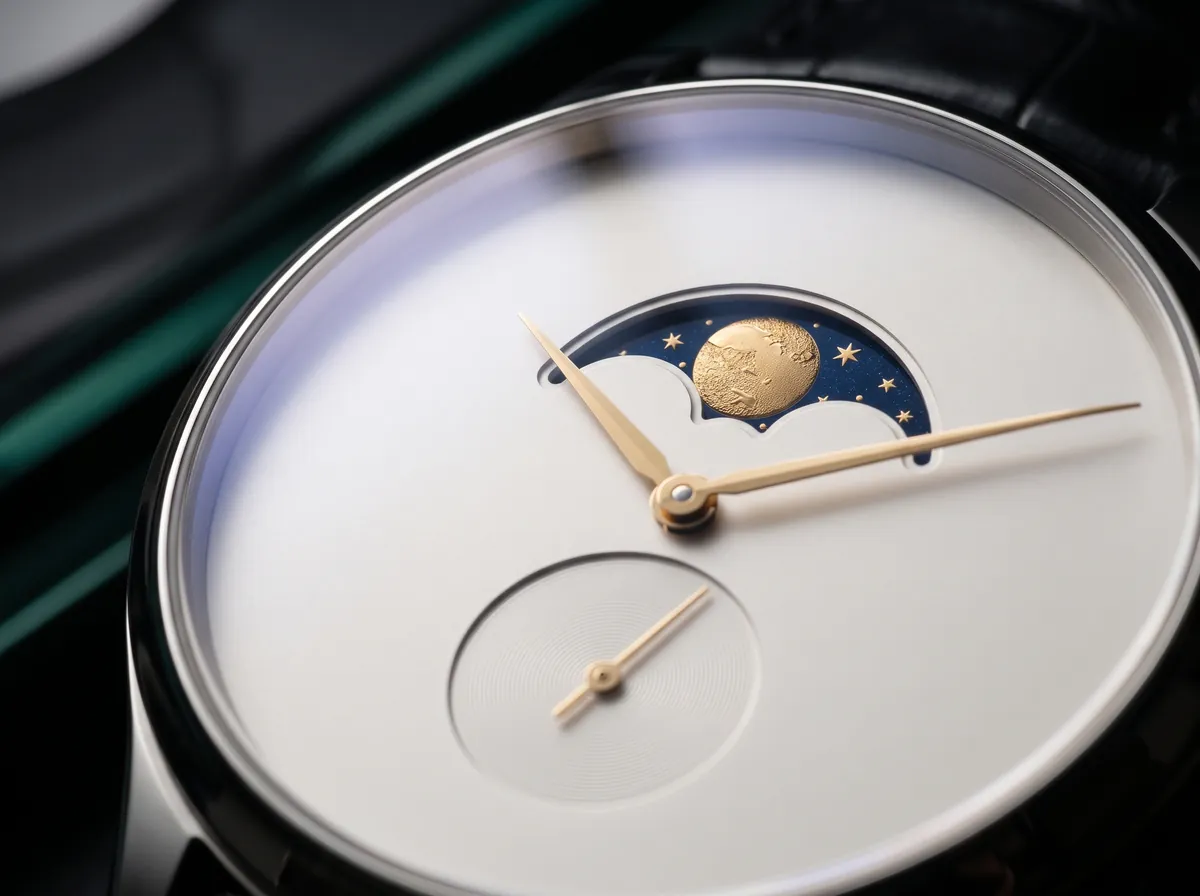
The moonphase is the most poetic of all. It follows the synodic month, the roughly 29.5 days from one new moon to the next, by means of a disc painted with two moons that advances a little each day. A common version uses a gear with 59 teeth and drifts by a day roughly every two and a half years. More precise versions drift far less, a quiet triumph of patient gearing.
Measuring and Travelling
A chronograph is a stopwatch built into a watch. Pushers beside the crown start, stop and reset a separate seconds hand, while subdials record the elapsed minutes and sometimes the hours. The everyday time keeps running undisturbed beneath it all.
Many chronographs carry a tachymeter scale on the bezel or around the edge of the dial. Start the chronograph as you pass a marker, stop it after one kilometre, and the seconds hand points to your average speed in kilometres per hour. It is a charming piece of arithmetic, done for you in metal and print.
For travellers there is the GMT or dual time watch. An additional hand shows a second time zone, often against a 24-hour scale, so home time stays in view while the main hands follow local time. It is a quiet comfort when you are calling someone across the world, or simply wondering whether it is morning where your family is.
Sound and Gravity
The minute repeater is among the most enchanting complications ever made. Slide a small lever on the side of the case and the watch chimes the time on tiny gongs: low notes for the hours, paired tones for the quarters and high notes for the minutes since. It was born before electric light, when hearing the time in the dark was a real gift, and it remains a feat of tuning as much as mechanics.
The tourbillon was invented by Abraham-Louis Breguet and patented in 1801. A pocket watch spends much of its life upright in a waistcoat, where gravity pulls gently on the balance and can affect its rhythm. Breguet's answer was to mount the escapement and balance in a rotating cage, usually turning once a minute, so that those small effects average out. On the wrist, the tourbillon is cherished as a spectacle of skill, often visible through an opening in the dial.
A complication is a question someone once asked, answered in tiny wheels.
Living With Complications
Strictly speaking, few people need a perpetual calendar or a minute repeater. That is rather the point. Complications are craft rather than necessity, a way for watchmakers to show patience, ingenuity and finesse, and for the wearer to carry a small marvel through the most ordinary day.
They do ask for a little understanding. On many movements the date mechanism is engaged in the hours around midnight, and setting the date then can strain its delicate parts. A perpetual calendar is happiest kept running, so wear it often or rest it on a winder, and let a watchmaker guide you if it ever needs resetting.
Once you know what each hand and window is doing, a complicated dial stops being a puzzle and becomes a conversation. The moon, the calendar, the chime: each is a reminder that time can be measured with poetry as well as precision.
Questions, answered
Why does a perpetual calendar need correcting in 2100?
In the Gregorian calendar, years divisible by four are leap years, except century years that are not divisible by 400. A perpetual calendar typically follows the four-year cycle, so 2100, which is not a leap year, calls for a single adjustment by a watchmaker.
What is the difference between a chronograph and a chronometer?
A chronograph is a complication: a stopwatch operated by pushers, with its own hands for elapsed time. A chronometer is a watch whose movement has passed official tests for precision. The two words sound alike, and a single watch can be one, the other or both.
Can I wear a complicated watch every day?
Yes, complicated watches are made to be worn. Treat the pushers and crown gently, avoid setting the date in the hours around midnight and keep a perpetual calendar running. Follow the maker's advice on servicing, and a complicated watch will be a faithful daily companion.
Three terms
- Synodic month
- The time from one new moon to the next, about 29.5 days, which a moonphase display follows.
- Tachymeter
- A scale used with a chronograph to read average speed over a known distance, such as one kilometre.
- Tourbillon
- A rotating cage holding the escapement and balance, invented by Abraham-Louis Breguet to average out the effect of gravity.
Image: AI generated illustration.