
How a Jacket Should Fit
Shoulders, sleeves, length and button stance: the tailor's checklist for a jacket that looks made for you.
A well-fitted jacket does something few garments manage: it gives your posture a frame, your shoulders a clean line and your whole outfit a sense of intention. The difference between a jacket that fits and one that nearly fits is a matter of millimetres, and of knowing where to look. Here is the tailor's checklist, from the shoulder seam to the sleeve, written with women's tailoring in mind.
Shoulders Above All
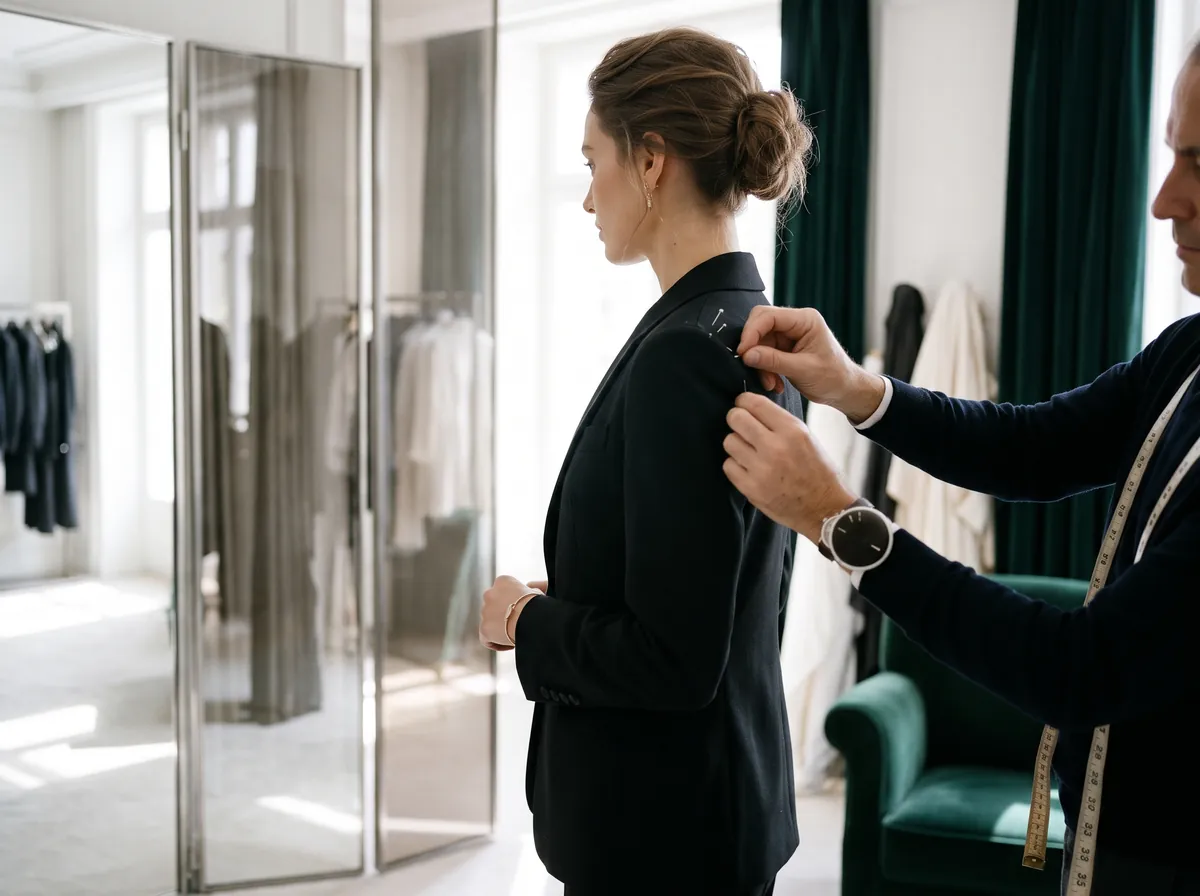
Begin at the top, because everything hangs from there. The shoulder seam should end at your shoulder bone, the small point where the arm begins, neither drooping past it nor stopping short. Let your arms fall naturally and look in the mirror from the side: the sleeve should fall cleanly from the shoulder, with no dent or ripple just below the pad.
Shoulders come first for a practical reason: they are the hardest part of a jacket to alter. Changing them means taking apart the sleeves, the shoulder construction and often the collar. If the shoulders fit and everything else is close, the jacket can almost always be made right. If they do not, choose another size or another cut.
Collar, Lapels and Closure
The collar should rest gently against the back of your neck, with no gap standing away from it, whether you look straight ahead or turn your head. The lapels should lie flat against the chest, rolling softly rather than lifting or buckling at the edge.
Now fasten the jacket. The front should close smoothly, with the cloth lying calm across the body. If creases radiate from the button in an X shape, the jacket is too tight at the waist or across the chest, and it will pull further when you sit or reach.
The button stance, the height of the fastening button, shapes the whole silhouette. A higher stance feels neat and structured; a lower one lengthens the lapels and opens the neckline. Neither is more correct than the other, but the point where the jacket fastens should sit comfortably near the narrowest part of your torso.
Sleeves and Length
Sleeves should end at the wrist bone, so that with a shirt beneath, about a centimetre of cuff shows. That fine line of white or blue looks deliberate and keeps the sleeve edge clean. Worn over a knit or bare arms, the same length leaves the hand free and the proportions light.
Length depends on the style. A cropped jacket ends at or just above the waist and pairs naturally with high-waisted trousers and fuller skirts. The classic hip-length jacket covers the top of the hip and suits almost everything. A longline jacket reaches down the thigh and looks fluid over slim trousers or a column dress. Choose the proportion you want and a jacket designed for it.
Waist, Back and Movement
Waist suppression, the gentle shaping built in at the waist, gives a jacket its form. It should follow your body without clinging. Turn and check the back: it should lie smooth, without horizontal folds below the collar or ripples down the centre, and any vents should hang closed when you stand still.
Then move. Lift your arms as if reaching for a high shelf, cross them, sit down. The jacket may rise a little, but it should not pull tight across the back or lift far at the hem. Before you decide, run through the checklist once more:
- shoulder seam at the shoulder bone, no dent below the pad
- collar against the neck, lapels lying flat
- no X-shaped pull when fastened
- sleeves at the wrist bone, about a centimetre of cuff visible
- a length that suits the style
- a smooth back and room to lift your arms
Fit begins at the shoulder; everything else is a conversation with your tailor.
From the Rail to Bespoke
A good tailor can refine a jacket within clear limits. Sleeve length can usually be adjusted, the waist taken in or let out at the seams and the hem altered slightly. Shoulders and any substantial change in overall length are another matter, because shortening a jacket noticeably moves the pockets and buttons out of balance. If the cuff buttons are functional, check the sleeve length before you buy, since working buttonholes make shortening far more complex.
Ready-to-wear jackets are cut to standard sizes, and with a few alterations they can fit beautifully. Made-to-measure starts from an existing pattern adjusted to your measurements, with a choice of cloth and details. Bespoke goes furthest: a pattern drafted for you alone and refined over several fittings. In construction, a canvassed jacket carries a floating layer of canvas that moulds to your body over time, while a fused jacket has its interlining bonded to the front, which keeps it light and crisp.
A jacket that fits does not announce itself. It simply lets you stand a little taller, move freely and forget about it for the rest of the day. Learn the few points that matter, trust the mirror and your own sense of ease, and let a good tailor do the rest.
Questions, answered
Can a tailor fix shoulders that are too wide?
Only with great difficulty. Altering shoulders means taking apart the sleeves, the shoulder construction and often the collar, and the result is rarely as clean as a jacket that fits there from the start. It is wiser to choose a size or cut that fits your shoulders and alter the rest.
What is the difference between made-to-measure and bespoke?
Made-to-measure adapts an existing pattern to your measurements and lets you choose the cloth and details. Bespoke begins with a pattern drafted for you alone and usually involves several fittings, so every line of the jacket is shaped around your body and posture.
How long should a women's jacket be?
It depends on the style and what you wear with it. A cropped jacket ends near the waist, the classic hip length covers the top of the hip and a longline jacket reaches down the thigh. Choose the proportion you want from the start, because overall length is very hard to alter.
Three terms
- Waist suppression
- The shaping built into a jacket at the waist so that it follows the natural line of the body.
- Canvas
- A woven interlining placed between the cloth and the lining that gives a jacket structure and moulds to the body.
- Button stance
- The height at which the fastening button sits on the front of a jacket.
Image: AI generated illustration.