
Cashmere, Silk and Merino: The Noble Fibres
Where the finest fibres come from, what makes them exceptional and how to care for them.
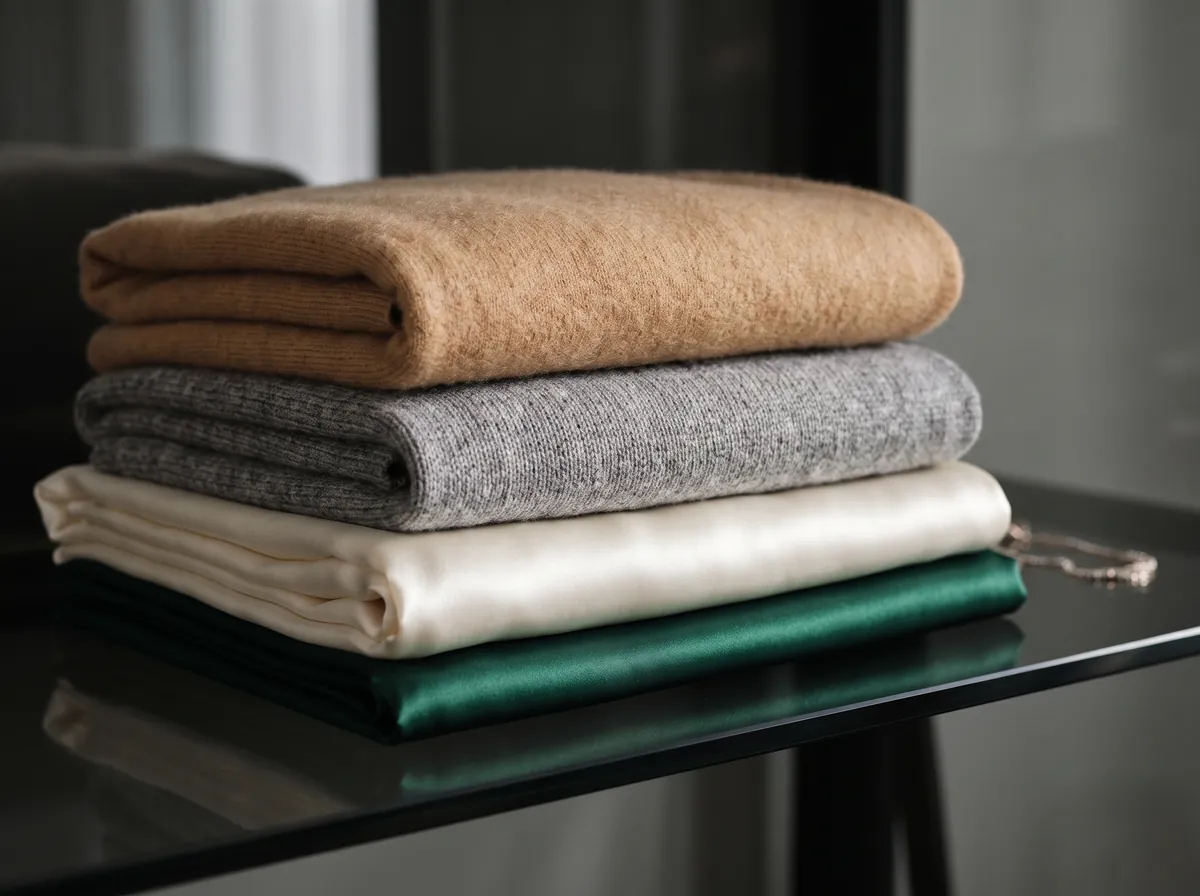
Some fabrics announce themselves before you see them. A cashmere knit warms in the palm, a length of silk slips over the wrist like cool water, a merino layer simply disappears against the skin. These are the noble fibres, and their quality begins long before the loom: on a high plateau, in a green pasture, in a mulberry grove. Here is where they come from, how to judge them with your hands and how to keep them for years.
A Gift of the Cold
Cashmere is the soft undercoat of the cashmere goat, a downy layer that grows beneath the coarse outer hair and protects the animal through hard winters. When the weather turns in spring, the goats begin to shed it, and herders comb or gather the fleece by hand. Most of the world's cashmere comes from Inner Mongolia and Mongolia, where long, harsh winters reward the goats with a dense and delicate down.
Fineness is measured in microns, thousandths of a millimetre. Cashmere fibres typically measure around 14 to 19 microns, far finer than a human hair, which is why the yarn feels so light and so warm at the same time. The raw fleece is sorted with care and the coarse guard hairs are removed, so that only the soft down goes on to be spun.
Two details reveal a fine knit. The first is fibre length: long fibres, spun firmly, leave fewer loose ends on the surface, so the garment pills less and keeps its shape. The second is ply, the number of single yarns twisted together to make the finished thread. Two-ply is the classic choice for a knit with body and balance; a higher ply adds warmth and weight rather than proving quality on its own.
Merino, the Quiet Performer
Merino comes from the merino sheep, a breed prized for the fineness of its fleece and raised above all in Australia and New Zealand. The finest grades, known as superfine, are measured in microns just like cashmere and spun into yarns so smooth that they sit comfortably against bare skin, without the prickle many people associate with wool.
Its gifts are practical as well as sensorial. The natural crimp of each fibre traps air, so merino keeps you warm on a cold morning and comfortable when the day grows mild. It takes up moisture vapour and lets it escape again, and it resists odour, which is why a fine merino turtleneck can be worn more than once before it needs washing. Next to the skin, beneath a blazer or a coat, it is the most versatile of the noble fibres.
The Thread from the Cocoon
Silk is the work of the Bombyx mori silkworm, which feeds on mulberry leaves and spins its cocoon from a single continuous filament. Unwound, cleaned and twisted, those filaments become a thread of extraordinary smoothness, with the soft lustre that has made silk a symbol of refinement for thousands of years.
The weight of silk is expressed in momme, a traditional Japanese unit. A higher momme means a denser, more opaque and more durable fabric, the kind you want for a blouse or a slip dress, while lighter weights float beautifully in scarves and linings.
The weave decides the character. Charmeuse has a liquid, satin face and a matt back, and it drapes close to the body. Crepe de chine is lighter, with a fine, softly grained surface and a gentle glow. Habotai is a plain, smooth weave, light and airy, much loved for scarves and linings.
Rare Relatives
Two Andean fibres complete the family. Alpaca, from the alpacas of the South American highlands, is silky, warm and pleasingly light, with a soft sheen that suits coats and generous knits. Vicuna is the rarest fibre of all. It comes from a wild and protected Andean animal and is finer still than cashmere, so a vicuna scarf belongs to the most exclusive corner of textile craft.
The finest fibres ask for little: cool water, a flat towel and patience.
Care That Lasts
Noble fibres reward gentle habits. Wash cashmere and merino by hand in cold water with a mild wool detergent, or choose the gentle wool cycle of your machine. Never wring them: press the water out in a towel, reshape the garment and dry it flat, away from direct heat.
Fold knits rather than hanging them, because their own weight slowly stretches the shoulders. Store them clean, since moths are drawn to traces of wear, and tuck blocks of cedar into the drawer for a fresh, protective scent. Silk prefers a pH-neutral detergent, a cool hand wash and a short rest rolled in a towel. Steam it rather than ironing it: steam lifts creases without flattening the lustre.
Choose fewer pieces and choose them well, and these fibres become companions rather than purchases. A cashmere knit softens with every winter, a silk blouse learns the shape of your movements, a merino layer travels everywhere without complaint. Touch, light and drape will tell you more than any label, and the care you give them is returned for many years.
Questions, answered
What does ply mean in cashmere?
Ply describes how many single yarns are twisted together to form the finished thread. Two-ply is the classic choice, giving a knit body and balance. A higher ply adds warmth and weight, but fibre length and the quality of the spinning matter just as much for how a knit wears.
Why is my new cashmere knit pilling?
In the first weeks, short or loose fibres work their way to the surface and form small balls where the knit rubs, under the arms or at the cuffs. Remove them gently with a cashmere comb. Knits spun from long fibres pill less and settle quickly.
Can silk go in the washing machine?
Follow the care label first. Many silks are happiest washed by hand in cool water with a pH-neutral detergent, then rolled in a towel and dried away from sunlight. If the label allows machine washing, use a delicate cycle and a mesh bag, and steam the piece afterwards.
Three terms
- Micron
- A thousandth of a millimetre, the unit used to measure the diameter of fine animal fibres.
- Momme
- A traditional Japanese unit that expresses the weight, and therefore the density, of silk fabric.
- Ply
- The number of single yarns twisted together to make a finished knitting thread.
Image: AI generated illustration.